|
|
|
SHARK INFO |
|
SHARK |
|
SHARK EVOLUTION |
|
|
|
SHARK DIVING |
|
SHARK DIVING 101 |
|
|
|
CONSERVATION |
|
|
|
PHOTOGRAPHY |
|
SHARK PHOTO TIPS |
|
|
|
RESOURCES |
|
|
|
WEB STUFF |
|
WHAT IS ELASMODIVER? Not just a huge collection of Shark Pictures: Elasmodiver.com contains images of sharks, skates, rays, and a few chimaera's from around the world. Elasmodiver began as a simple web based shark field guide to help divers find the best places to encounter the different species of sharks and rays that live in shallow water but it has slowly evolved into a much larger project containing information on all aspects of shark diving and shark photography. There are now more than 10,000 shark pictures and sections on shark evolution, biology, and conservation. There is a large library of reviewed shark books, a constantly updated shark taxonomy page, a monster list of shark links, and deeper in the site there are numerous articles and stories about shark encounters. Elasmodiver is now so difficult to check for updates, that new information and pictures are listed on an Elasmodiver Updates Page that can be accessed here:
|
|
_ |
GREEN SAWFISH |
|
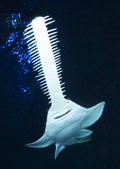
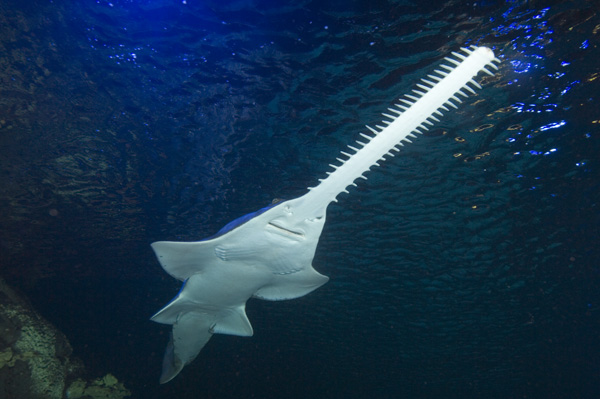
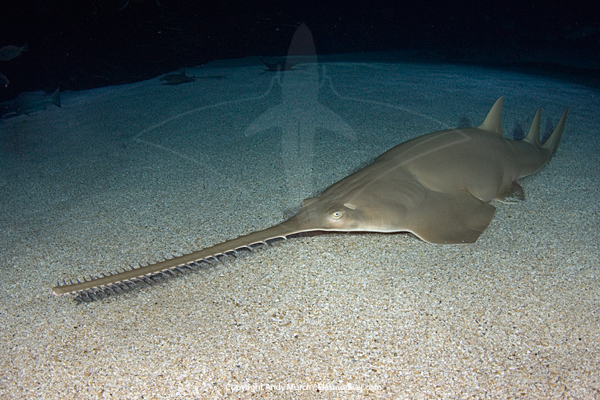
Green Sawfish Images by Andy Murch. All rights reserved View all available Green Sawfish Pictures in the Shark Pictures Database Green sawfish, Longcomb Sawfish. Latin Name: Pristis zijsron Family: Pristidae Identification: Overall flattened sharklike body. Elongated flattened rostrum (saw) accounts for about 1/3 of overall length. Saw contains 24 to 34 pairs of rostral teeth which are further apart near the base of the rostrum. First dorsal fin originates behind pelvic fins. Lower caudal lobe is greatly reduced. Size: Maximum length 730cm. Habitat: Sand and mud bottoms in estuaries, bays, and lagoons. Also in fresh or brackish water environments in lakes and rivers. Abundance and distribution: Uncommon due to habitat loss and over fishing. Easily caught in fishing nets where removal without injury to the animal is difficult. Also previously hunted for its saw which was sold in curio shops. Northern Indian Ocean and Western Pacific from South Africa to Australia. Behavior: Swims into schools of fish and thrashes its saw from side to side, wounding and killing the fish which it then recovers. May also use its saw to dig for crustaceans and mollusks in the sediment. Reproduction: Ovoviviparous. Young are born with flexible rostrums in which the teeth are covered with a sheath of skin to avoid injury to the mother. After birth the rostrum unrolls and hardens. Observations: Photographs: Similar species: The Green Sawfish shares its range with at least 3 other species. The Dwarf Sawfish (Pristis clavata) has a rounder head and evenly spaced rostral teeth, the Narrow Sawfish (Anoxypristis cuspidata) has a much narrower rostrum, and the Freshwater or Broadbill Sawfish (Pristis microdon) has a distinct lower tail lobe, a broader rostral base, and evenly spaced rostral teeth with the leading pair angled forward. Reaction to divers: Diving logistics: There are no locations that I know of where divers can reliably find Green Sawfish due to their rarity and preference for turbid environments. Any information on sightings of this species by divers and hikers would be very welcome. Other diving locations submitted by readers: References:
|
|
|
|
SHARK TRIPS |
 |
 |
 |
 |
 |
 |
 |
 |
|
MORE EXPEDITIONS |
 |
 |
 |
 |
 |
 |
 |
 |
 |
 |
 |
 |
|
|
|
SPONSORS |
 |
 |
|
ADVERTISERS |
|
|


|
|
|
ELASMO-BLOGS |
 |
 |
 |
 |
 |