|
INFRACLASS EUSELACHII
- SHARKS
Order HEXANCHIFORMES -
Sixgill, Sevengill
and Frilled Sharks
Family CHLAMYDOSELA - Frilled Sharks
Chlamydoselachus anguineus
- Frilled shark
Family HEXANCHIDAE - Sixgill and Sevengill Sharks
Heptranchias perlo
- Sharpnose
sevengill shark
Hexanchus griseus
- Bluntnose
sixgill shark
Hexanchus nakamurai
- Bigeye sixgill
shark
Hexanchus vitulus - Atlantic bigeye sixgill shark
Notorynchus cepedianus
- Broadnose
or spotted sevengill shark
Order SQUALIFORMES - Dogfish Sharks
Family
CENTROPHORIDAE
- Gulper Sharks
Centrophorus acus
- Needle dogfish
Centrophorus granulosus
- Gulper
shark
Centrophorus harrissoni
- Dumb
gulper shark
Centrophorus lusitanicus
- Lowfin
gulper shark
Centrophorus moluccensis
-
Smallfin gulper shark
Centrophorus niaukang
- Taiwan
gulper shark
Centrophorus squamosus
- Leafscale
gulper shark
Centrophorus tesselatus
- Mosaic
gulper shark
Centrophorus uyato
- Little gulper
shark
Deania calcea
- Birdbeak dogfish
Deania hystricosum
- Rough
longnose dogfish
Deania profundorum
- Arrowhead
dogfish
Deania quadrispinosum
- Longsnout
dogfish
Family
DALATIIDAE
- Kitefin Sharks
Dalatias licha
- Kitefin shark
Euprotomicroides zantedeschia
-
Taillight shark
Europtomicrus bispinatus
- Pygmy
shark
Heteroscymnoides marleyi
-
Longnose pygmy shark
Isistius brasiliensis
-
Cookiecutter or cigar shark
Isistius plutodus
- Largetooth
cookiecutter shark
Mollisquama
mississippiensis
- Grace et al, 2019. Mississippi kitefin shark
Mollisquama parini
- Softskin
dogfish
Squaliolus laticaudus
- Spined
pygmy shark
Family ECHINORHINIDAE
- Bramble Sharks
Echinorhinus brucus
- Bramble
shark
Echinorhinus cookei
- Prickly
shark
Family
ETMOPTERIDAE
- Lantern Sharks
Aculeola nigra
- Hooktooth dogfish
Centroscyllium fabricii
- Black
dogfish
Centroscyllium granulatum
-
Granular dogfish
Centroscyllium kamoharai
-
Bareskin dogfish
Centroscyllium nigrum
- Combtooth
dogfish
Centroscyllium ornatum
- Ornate
dogfish
Centroscyllium ritteri
- Whitefin
dogfish
Etmopterus baxteri
- New Zealand
lanternshark
Etmopterus
benchleyi
- Benchley's lanternshark
Etmopterus brachyurus
- Shorttail
lanternshark
Etmopterus bullisi
- Lined
lanternshark
Etmopterus carteri
- Cylindrical
lanternshark
Etmopterus decacuspidatus
-
Combtooth lanternshark
Etmopterus gracilispinis
-
Broadband lanternshark
Etmopterus granulosus
- Southern
lanternshark
Etmopterus hillianus
- Carribean
lanternshark
Etmopterus lucifer
- Blackbelly
lanternshark
Etmopterus perryi
- Dwarf
lanternshark
Etmopterus polli
- African
lanternshark
Etmopterus princeps
- Great
lanternshark
Etmopterus pusillus
- Smooth
lanternshark
Etmopterus schultzi
- Fringefin
lanternshark
Etmopterus sentosus
- Thorny
lanternshark
Etmopterus spinax
- Velvet belly lanternshark
Etmopterus unicolor
- Brown
lanternshark
Etmopterus villosus
- Hawaiian
lanternshark
Etmopterus virens
- Green
lanternshark
Family
SOMNIOSIDAE
- Sleeper Sharks
Centroscymnus coelolepis
-
Portuguese dogfish
Centroscymnus crepidater
-
Longnose velvet dogfish
Centroscymnus cryptacanthus
-
Shortnose velvet dogfish
Centroscymnus macracanthus
-
Largespine velvet dogfish
Centroscymnus owstoni
- Roughskin
dogfish
Centroscymnus plunketi
- Plunket
shark
Scymnodalatias sherwoodi
-
Sherwood dogfish
Scymnodon ichiharai
- Japanese
velvet dogfish
Scymnodon ringens
- Knifetooth
dogfish
Scymnodon squamulosus
- Greenland
sleeper shark
Somniosus microcephalus - Greenland Shark
Somniosus pacificus
- Pacific
sleeper shark
Somniosus rostratus
- Little
sleeper shark
Family SQUALIDAE
- Dogfish Sharks
Cirrhigaleus asper
- Roughskin spurdog
Cirrhigaleus australis -
Southern mandarin dogfish
Cirrhigaleus barbifer
- Mandarin
dogfish
Squalus acanthias
- Spiny dogfish
Squalus albifrons -
Eastern highfin spurdog
Squalus
altipinnis
- Western highfin spurdog
Squalus blainvillei
- Longnose
spurdog
Squalus brevirostris -
Japanese shortnose spurdog
Squalus bucephalus -
Bighead spurdog
Squalus chloroculus -
Greeneye spurdog
Squalus crassispinus -
Fatspine spurdog
Squalus cubensis
- Cuban dogfish
Squalus edmundsi -
Edmund's spurdog
Squalus formosus - Taiwan
spurdog
Squalus grahami - Eastern
longnose spurdog
Squalus griffini -
Northern spiny dogfish
Squalus hawaiiensis -
Hawaiian dogfish
Squalus hemipinnis -
Indonesian shortsnout spurdog
Squalus japonicus
- Japanese
spurdog
Squalus lalannei -
Seychelles spurdog
Squalus megalops
- Shortnose
spurdog
Squalus melanurus
- Blacktail
spurdog
Squalus mitsukurii
- Shortspine
spurdog
Squalus montalbani -
Indonesian greeneye spurdog
Squatina nasutus
- Western longnosed spurdog
Squalus notocaudatus -
Bartail spurdog
Squalus rancureli
- Cyrano spurdog
Squalus raoulensis -
Kermadec spiny dogfish
Squalus suckleyi
-
Pacific spiny dogfish
Family OXYNOTIDAE
- Roughsharks
Oxynotus bruniensis
- Prickly
dogfish
Oxynotus carribaeus
- Carribean
roughshark
Oxynotus centrina
- Angular
roughshark
Oxynotus japonicus
- Japanese
roughshark
Oxynotus paradoxus
- Sailfin
roughshark
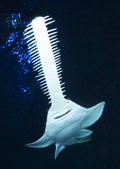
Order PRISTIOPHORIFORMES - Sawsharks
Family PRISTIOPHORIDAE
- Sawsharks
Pristiophorus nancyae
- African dwarf sawshark
Pliotrema warreni
- Sixgill
sawshark
Pristiophorus cirratus
- Longnose
sawshark
Pristiophorus japonicus
- Japanese
sawshark
Pristiophorus nudipinnis
-
Shortnose sawshark
Pristiophorus schroederi
- Bahamas
sawshark
Order SQUATINIFORMES - Angelsharks
Family SQUATINIDAE
- Angelsharks
Squatina aculeata
- Sawback angelshark
Squatina albipunctata
- Eastern Australian angelshark
Squatina
africana
- African angelshark
Squatina
argentina
- Argentine angelshark
Squatina
australis
- Australian angelshark
Squatina californica
- Pacific angelshark
Squatina caillieti - Philippine
angelshark
Squatina
dumeril
- Sand devil
Squatina
formosa
- Taiwan angelshark
Squatina guggenheim - Angular angelshark
Squatina
japonica
- Japanese angelshark
Squatina
nebulosa
- Clouded angelshark
Squatina
oculata
- Smoothback angelshark
Squatina squatina
- Common Angel Shark
Squatina
tergocellata
- Ornate angelshark
Squatina
tergocellatoides
- Ocellated angelshark
Order HETERODONTIFORMES - Bullhead Sharks
Family HETERODONTIDAE
- Bullhead Sharks
Heterodontus francisci
- Horn
shark
Heterodontus galeatus
- Crested
bullhead shark
Heterodontus japonicus
- Japanese
bullhead shark
Heterodontus mexicanus
- Mexican
hornshark
Heterodontus omanensis -
Oman bullhead shark
Heterodontus portusjacksoni
- Port
Jackson shark
Heterodontus quoyi
- Galapagos
bullhead shark
Heterodontus ramalheira
-
Whitespotted bullhead shark
Heterodontus zebra
- Zebra
bullhead shark
Order ORECTOLOBIFORMES - Carpetsharks
Family PARASCYLLIDAE
- Collared Carpetsharks
Cirrhoscyllium expolitum
-
Barbelthroat carpetshark
Cirrhoscyllium formosanum
- Taiwan
saddled carpetshark
Cirrhoscyllium japonicum
- Saddled
carpetshark
Parascyllium ferrugineum
- Rusty
carpetshark
Parascyllium multimaculatum
-
Tasmanian carpetshark
Parascyllium variolatum
- Necklace
carpetshark or Varied carpetshark
Family BRACHAELURIDAE
- Blind Sharks
Brachaelurus waddi
- Blind shark
Heteroscyllium colcloughi
-
Colclough's carpetshark
Family ORECTOLOBIDAE
- Wobbegongs
Eucrossorhinus dasypogon
-
Tasselled wobbegong
Orectolobus floridus
- Floral wobbegong
Orectolobus halei - Banded wobbegong
Orectolobus hutchinsi - Western
wobbegong
Orectolobus japonicus
- Japanese
wobbegong
Orectolobus leptolineatus
- Indonesian wobbegong
Orectolobus maculatus
- Spotted
wobbegong
Orectolobus ornatus
- Ornate wobbegong
Orectolobus parvimaculatus - Dwarf
spotted wobbegong
Orectolobus reticulatus
- Network wobbegong
Orectolobus sp. A -
Papuan wobbegong
Orectolobus wardi
-
Northern wobbegong
Sutorectus tentaculatus
- Cobbler
wobbegong
Family HEMISCYLLIDAE
- Longtailed Carpetsharks
Chiloscyllium arabicum
- Arabian
carpetshark
Chiloscyllium burmensis
- Burmese
bambooshark
Chiloscyllium caerulopunctatum
-
Bluespotted bambooshark
Chiloscyllium griseum
- Grey
bambooshark
Chiloscyllium hasselti
-
Indonesian bambooshark
Chiloscyllium indicum
- Slender
bambooshark
Chiloscyllium plagiosum
-
Whitespotted bambooshark
Chiloscyllium punctatum
-
Brownbanded bambooshark
Hemiscyllium freycineti
-
Indonesian speckled epaulette shark
Hemiscyllium galei
- Cendrawasi
epaulette shark
Hemiscyllium hallstromi
- Papuan
epaulette shark
Hemiscyllium halmahera
- Halmahera
epaulette shark
Hemiscyllium henryi
- Henrys
or Triton Bay epaulette shark
Hemiscyllium
michaeli
- Milne Bay
epaulette shark
Hemiscyllium ocellatum
- Epaulette
shark
Hemiscyllium strahani
- Hooded
epaulette shark
Hemiscyllium trispeculare
-
Speckled epaulette shark
Hemiscyllium sp.
- Seychelles
epaulette shark
Family GINGLYMOSTOMATIDAE
- Nurse Sharks
Psuedoginglymostoma brevicaudatum
-
Shorttail nurse shark
Ginglymostoma
cirratum
- Nurse
shark
Ginglymostoma unami -
Pacific nurse shark
Nebrius ferrugineus
- Tawny nurse
shark
Family STEGOSTOMATIDAE
- Zebra Sharks
Stegostoma fasciatum
- Zebra shark
Family RHINCODONTIDAE
- Whale Sharks
Rhincodon typus
- Whale shark
Order LAMNIFORMES - Mackerel Sharks
Family ODONTASPIDIDAE
- Sand Tiger Sharks
Carcharias taurus
- Sand tiger,
spotted raggedtooth, or grey nurse shark
Odontaspis ferox
- Smalltooth sand
tiger or bumpytail raggedtooth
Odontaspis noronhai
- Bigeye sand
tiger
Family PSEUDOCARCHARIDAE
- Crocodile Sharks
Pseudocarcharias kamoharai
-
Crocodile shark
Family MITSUKURINIDAE
- Goblin Sharks
Mitsukurina owstoni
- Goblin shark
Family MEGACHASMIDAE
- Megamouth Sharks
Megachasma pelagios
- Megamouth
Shark
Family ALOPIIDAE
- Thresher Sharks
Alopias pelagicus
- Pelagic
thresher
Alopias superciliosus
- Bigeye
thresher
Alopias vulpinus
- Common thresher shark
Family CETORHINIDAE
- Basking Sharks
Cetorhinus maximus
- Basking shark
Family LAMNIDAE
- Mackerel Sharks
Carcharodon carcharias
- Great
white shark
Isurus oxyrinchus
- Shortfin mako
Isurus paucus
- Longfin mako
Lamna ditropis
- Salmon shark
Lamna nasus
- Pobeagle shark
Order CARCHARHINIFORMES - Ground Sharks
Family SCYLIORHINIDAE
- Catsharks
Apristurus albisoma
- Nakaya & Séret, 1999 (White-bodied catshark)
Apristurus
ampliceps
- Sasahara,
K. Sato & Nakaya, 2008 (Roughskin catshark)
Apristurus
aphyodes
- Nakaya & Stehmann, 1998 (White ghost catshark)
Apristurus
australis
- K. Sato, Nakaya & Yorozu, 2008 (Pinocchio catshark)
Apristurus
breviventralis
- Kawauchi, Weigmann & Nakaya, 2014 (Shortbelly catshark) [2]
Apristurus brunneus
-
C. H. Gilbert 1892
Brown catshark
Apristurus
bucephalus
- W. T. White, Last & Pogonoski, 2008 (Bighead catshark)
Apristurus
canutus
- S. Springer & Heemstra, 1979 (Hoary catshark)
Apristurus
exsanguis
- K. Sato, Nakaya & A. L. Stewart, 1999 (Flaccid catshark)
Apristurus
fedorovi
- Dolganov, 1985 (Fedorov's catshark)
Apristurus
garricki
- K. Sato, A. L. Stewart & Nakaya, 2013 (Garrick's catshark) [3]
Apristurus
gibbosus
- Y. T. Chu, Q. W. Meng & S. Li, 1985 (Humpback catshark)
Apristurus
herklotsi
- Fowler, 1934 (Longfin catshark)
Apristurus
indicus
- A. B. Brauer, 1906 (Smallbelly catshark)
Apristurus
internatus
- S. M. Deng, G. Q. Xiong & H. X. Zhan, 1988 (Shortnose demon catshark)
Apristurus
investigatoris
- Misra, 1962 (Broadnose catshark)
Apristurus
japonicus
- Nakaya, 1975 (Japanese catshark)
Apristurus
kampae
- L. R. Taylor, 1972 (Longnose catshark)
Apristurus
laurussonii
- Sæmundsson, 1922 (Iceland catshark)
Apristurus
longicephalus
- Nakaya, 1975 (Longhead catshark)
Apristurus
macrorhynchus
- S. Tanaka (I), 1909 (Flathead catshark)
Apristurus
macrostomus
- Q. W. Meng, Y. T. Chu & S. Li, 1985 (Broadmouth catshark)
Apristurus
manis
- S. Springer, 1979 (Ghost catshark)
Apristurus
melanoasper
- Iglésias, Nakaya & Stehmann, 2004 (Black roughscale catshark)
Apristurus
microps
- Gilchrist, 1922 (Smalleye catshark)
Apristurus
micropterygeus
- Q. W. Meng, Y. T. Chu & S. Li, 1986 (Smalldorsal catshark)
Apristurus
nakayai
- Iglésias, 2013 (Milk-eye catshark) [4]
Apristurus
nasutus
- F. de Buen, 1959 (Largenose catshark)
Apristurus
parvipinnis
- S. Springer & Heemstra, 1979 (Smallfin catshark)
Apristurus
pinguis
- S. M. Deng, G. Q. Xiong & H. X. Zhan, 1983 (Bulldog catshark)
Apristurus
platyrhynchus
- S. Tanaka (I), 1909 (Spatulasnout catshark or Borneo catshark)
Apristurus
profundorum
- Goode & T. H. Bean, 1896 (Deepwater catshark)
Apristurus
riveri
- Bigelow & Schroeder, 1944 (Broadgill catshark)
Apristurus
saldanha
- Barnard, 1925 (Saldanha catshark)
Apristurus
sibogae
- M. C. W. Weber, 1913 (Pale catshark)
Apristurus
sinensis
- Y. T. Chu & A. S. Hu, 1981 (South China catshark)
Apristurus
spongiceps
- C. H. Gilbert, 1905 (Spongehead catshark)
Apristurus
stenseni
- S. Springer, 1979 (Panama ghost catshark)
Apristurus
sp. X
- Not yet described (Galbraith's catshark)
Apristurus
sp. 3
- Not yet described (Black wonder catshark)
Apristurus
sp.
- nov. Not yet described (White-edged catshark)
Apristurus
sp.
- Not yet described (Gray ghost catshark)
Asymbolus
analis
- (J. D. Ogilby, 1885) (Australian spotted catshark)
Asymbolus
funebris
- Compagno, Stevens & Last, 1999 (Blotched catshark)
Asymbolus
galacticus
- Séret & Last, 2008 (Starry catshark)
Asymbolus
occiduus
- Last, M. F. Gomon & Gledhill, 1999 (Western spotted catshark)
Asymbolus
pallidus
- Last, M. F. Gomon & Gledhill, 1999 (Pale spotted catshark)
Asymbolus
parvus
- Compagno, Stevens & Last, 1999 (Dwarf catshark)
Asymbolus
rubiginosus
- Last, M. F. Gomon & Gledhill, 1999 (Orange-spotted catshark)
Asymbolus
submaculatus
- Compagno, Stevens & Last, 1999 (Variegated catshark)
Asymbolus
vincenti
- (Zietz (fi), 1908) (Gulf catshark)
Atelomycterus
baliensis
- W. T. White, Last & Dharmadi, 2005 (Bali catshark)
Atelomycterus
erdmanni
- Fahmi & W. T. White, 2015 (Spotted-belly catshark) [1]
Atelomycterus
fasciatus
- Compagno & Stevens, 1993 (Banded sand catshark)
Atelomycterus
macleayi
- Whitley, 1939 (Australian marbled catshark)
Atelomycterus marmoratus
- Anonymous, referred to E. T. Bennett, 1830 (Coral catshark)
Atelomycterus
marnkalha
- Jacobsen & M. B. Bennett, 2007 (Eastern banded catshark)
Aulohalaelurus
kanakorum
- Séret, 1990 (Kanakorum catshark)
Aulohalaelurus
labiosus
- Waite, 1905 (Australian blackspotted catshark)
Bythaelurus alcockii - (Garman, 1913) (Arabian catshark) [1]
Bythaelurus canescens - (Günther, 1878) (Dusky catshark)
Bythaelurus clevai - (Séret, 1987) (Broadhead catshark)
Bythaelurus dawsoni - (S. Springer, 1971) (New Zealand catshark)
Bythaelurus giddingsi - J. E. McCosker, Long & C. C. Baldwin, 2012
(Galápagos catshark)
Bythaelurus hispidus - (Alcock, 1891) (Bristly catshark)
Bythaelurus immaculatus - (Y. T. Chu & Q. W. Meng, 1982) (Spotless
catshark)
Bythaelurus incanus - Last & J. D. Stevens, 2008 (Sombre catshark)
Bythaelurus lutarius - (S. Springer & D'Aubrey, 1972) (Mud
catshark)
Bythaelurus naylori - Ebert & Clerkin, 2015 (Dusky snout
catshark) [1]
Bythaelurus stewarti - Weigmann, Kaschner, and Thiel, 2018 (Error
Seamount catshark)[2]
Bythaelurus tenuicephalus - Kaschner, Weigmann & Thiel, 2015 (Narrowhead
catshark) [3]
Cephaloscyllium
albipinnum
- Last, Motomura & W. T. White, 2008 (Whitefin swellshark)
Cephaloscyllium
cooki
- Last, Séret & W. T. White, 2008 (Cook's swellshark)
Cephaloscyllium
fasciatum
- W. L. Y. Chan, 1966 (Reticulated swellshark)
Cephaloscyllium
hiscosellum
- W. T. White & Ebert, 2008 (Australian reticulate swellshark)
Cephaloscyllium
isabellum
- Bonnaterre, 1788 (Draughtsboard shark)
Cephaloscyllium
laticeps
- A. H. A. Duméril, 1853 (Australian swellshark)
Cephaloscyllium
pictum
- Last, Séret & W. T. White, 2008 (Painted swellshark)
Cephaloscyllium
sarawakensis
- Ka. Yano, A. Ahmad & Gambang, 2005 (Sarawak pygmy swellshark)
Cephaloscyllium
signourum
- Last, Séret & W. T. White, 2008 (Flagtail swellshark)
Cephaloscyllium
silasi
- Talwar, 1974 (Indian swellshark)
Cephaloscyllium
speccum
- Last, Séret & W. T. White, 2008 (Speckled swellshark)
Cephaloscyllium
stevensi
- E. Clark & J. E. Randall, 2011 (Steven's swellshark)
Cephaloscyllium
sufflans
- Regan, 1921 (Balloon shark)
Cephaloscyllium umbratile
- D. S. Jordan & Fowler, 1903 (Blotchy swellshark)
Cephaloscyllium
variegatum
- Last, Séret & W. T. White, 2008 (Saddled swellshark)
Cephaloscyllium ventriosum
- Garman, 1880 (Swellshark)
Cephaloscyllium
zebrum
- Last, Séret & W. T. White, 2008 (Narrowbar swellshark)
Cephaloscyllium
sp.
- Not yet described (Philippine swellshark)
Cephaloscyllium
sp.
- Not yet described (Tiger swellshark)
Cephaloscyllium
sp.
- Not yet described (New Guinea swellshark)
Cephaloscyllium
sp.
- Not yet described (Dwarf balloon shark)
Cephaloscyllium
sp.
- Not yet described (Dwarf oriental swellshark)
Cephaloscyllium
sp.
- Not yet described (New Caledonia swellshark)
Cephaloscyllium
sp.
- Not yet described (Red Sea swellshark)
Cephalurus cephalus
- Lollipop
catshark
Figaro boardmani
- (Whitley, 1928) (Australian sawtail catshark)
Figaro striatus
- Gledhill, Last & W. T. White, 2008 (Northern sawtail catshark)
Galeus
antillensis
- S. Springer, 1979 (Antilles catshark)
Galeus
arae
- Nichols, 1927 (Roughtail catshark)
Galeus
atlanticus
- Vaillant, 1888 (Atlantic sawtail catshark)
Galeus
cadenati
- S. Springer, 1966 (Longfin sawtail catshark)
Galeus
eastmani
- D. S. Jordan & Snyder, 1904 (Gecko catshark)
Galeus
gracilis
- Compagno & Stevens, 1993 (Slender sawtail catshark)
Galeus
longirostris
- Tachikawa & Taniuchi, 1987 (Longnose sawtail catshark)
Galeus melastomus
- Rafinesque, 1810 (Blackmouth catshark)
Galeus
mincaronei
- Soto, 2001 (Southern sawtail catshark)
Galeus
murinus
- Collett, 1904 (Mouse catshark)
Galeus
nipponensis
- Nakaya, 1975 (Broadfin sawtail catshark)
Galeus
piperatus
- S. Springer & M. H. Wagner, 1966 (Peppered catshark)
Galeus
polli
- Cadenat, 1959 (African sawtail catshark)
Galeus
priapus
- Séret & Last, 2008 (Phallic catshark)
Galeus
sauteri
- D. S. Jordan & R. E. Richardson, 1909 (Blacktip sawtail catshark)
Galeus
schultzi
- S. Springer, 1979 (Dwarf sawtail catshark)
Galeus
springeri
- Konstantinou & Cozzi, 1998 (Springer's sawtail catshark)
Halaelurus
boesemani
- S. Springer & D'Aubrey, 1972 (Speckled catshark)
Halaelurus
buergeri
- (J. P. Müller & Henle, 1838) (Blackspotted catshark)
Halaelurus
lineatus
- Bass, D'Aubrey & Kistnasamy, 1975 (Lined catshark)
Halaelurus
maculosus
- W. T. White, Last & Stevens, 2007 (Indonesian speckled catshark)
Halaelurus natalensis
- (Regan, 1904) (Tiger catshark)
Halaelurus
quagga
- (Alcock, 1899) (Quagga catshark)
Halaelurus
sellus
- W. T. White, Last & Stevens, 2007 (Rusty catshark)
Haploblepharus edwardsii
-
(Schinz, 1822)
Puffadder shyshark
Haploblepharus fuscus
-
(J. L. B. Smith, 1950)
Brown shyshark
Haploblepharus
kistnasamyi -
(Human & Compagno, 2006) Natal shyshark
Haploblepharus pictus
-
(J. P. Müller & Henle, 1838)
Dark shyshark
Holohalaelurus
favus
- Human, 2006 (Honeycomb Izak)
Holohalaelurus
grennian
- Human, 2006 (Grinning Izak)
Holohalaelurus
melanostigma
- (Norman, 1939) (Crying Izak)
Holohalaelurus
punctatus
- (Gilchrist, 1914) (White-spotted Izak)
Holohalaelurus
regani
- (Gilchrist, 1922) (Izak catshark)
Parmaturus
albimarginatus
- Séret & Last, 2007 (White-tip catshark)
Parmaturus
albipenis
- Séret & Last, 2007 (White-clasper catshark)
Parmaturus
p. angelae
- Soares, Carvalho, et al, 2019
Parmaturus
bigus
- Séret & Last, 2007 (Beige catshark)
Parmaturus
campechiensis
- S. Springer, 1979 (Campeche catshark)
Parmaturus lanatus
- Séret & Last, 2007 (Velvet catshark)
Parmaturus macmillani
- Hardy, 1985 (McMillan's cat shark)
Parmaturus melanobranchus
- (W. L. Y. Chan, 1966) (Blackgill catshark)
Parmaturus pilosus
- Garman, 1906 (Salamander shark)
Parmaturus xaniurus
- (C. H. Gilbert, 1892) (Filetail catshark)
Parmaturus sp.
- Not yet described (Roughback catshark)
Parmaturus sp.
- Not yet described (Indonesian filetail catshark)
Parmaturus sp.
- Not yet described (Gulf of Mexico filetail)
Pentanchus profundicolus
-
Froese, Rainer and Pauly, Daniel, eds. 2011
(Onefin
catshark)
Poroderma africanum
- (J. F. Gmelin, 1789) (Striped catshark or Pyjama shark)
Poroderma pantherinum
- (J. P. Müller & Henle, 1838) (Leopard catshark)
Schroederichthys
bivius
- (J. P. Müller & Henle, 1838) (Narrowmouthed catshark)
Schroederichthys chilensis
- (Guichenot, 1848) (Redspotted catshark)
Schroederichthys
maculatus
- S. Springer, 1966 (Narrowtail catshark)
Schroederichthys
saurisqualus
- Soto, 2001 (Lizard catshark)
Schroederichthys
tenuis
- S. Springer, 1966 (Slender catshark)
Scyliorhinus
boa
- Goode & T. H. Bean, 1896 (Boa catshark)
Scyliorhinus
cabofriensis
- K. D. A. Soares, U. L. Gomes & M. R. de Carvalho, 2016
Scyliorhinus canicula
- (Linnaeus, 1758) (Small-spotted catshark)
Scyliorhinus
capensis
- (J. P. Müller & Henle, 1838) (Yellowspotted catshark)
Scyliorhinus
cervigoni
- Maurin & M. Bonnet, 1970 (West African catshark)
Scyliorhinus
comoroensis
- L. J. V. Compagno, 1988 (Comoro catshark)
Scyliorhinus dumamelii
- Garman 1913 Southern Small-spotted Catshark
Scyliorhinus
garmani
- (Fowler, 1934) (Brownspotted catshark)
Scyliorhinus
haeckelii
- (A. Miranda-Ribeiro, 1907) (Freckled catshark)
Scyliorhinus hesperius
- S. Springer, 1966 (Whitesaddled catshark)
Scyliorhinus
meadi
- S. Springer, 1966 (Blotched catshark)
Scyliorhinus retifer
- (Garman, 1881) (Chain catshark)
Scyliorhinus
stellaris
- (Linnaeus, 1758) (Nursehound)
Scyliorhinus
tokubee
- Shirai, S. Hagiwara & Nakaya, 1992 (Izu catshark)
Scyliorhinus
torazame
- (S. Tanaka (I), 1908) (Cloudy catshark)
Scyliorhinus
torrei
- Howell-Rivero, 1936 (Dwarf catshark)
Scyliorhinus
ugoi
- K. D. A. Soares, Gadig & U. L. Gomes, 2015 (Dark freckled catshark)
Family PROSCYLLIDAE
- Finback Catsharks
Ctenacis fehlmanni
- Harlequin
catshark
Eridacnis barbouri
- Cuban
ribbontail catshark
Eridacnis radcliffei
- Pygmy
ribbontail catshark
Eridacnis sinuans
- African
ribbontail catshark
Gollum attentuatus
- Slender
smoothhound
Proscyllium habereri
- Graceful
catshark
Family PSEUDOTRIAKIDAE
- False Catsharks
Pseudotriakis microdon
- False
catshark
Family LEPTOCHARIIDAE
- Barbeled Houndshark
Leptocharias smithii
- Barbeled
houndshark
Family TRIAKIDAE
- Houndsharks
Furgaleus macki
- Whiskery shark
Galeorhinus galeus
- Tope shark
Gogolia filewoodi
- Sailback
houndshark
Hemitriakis japanica
- Japanese
topeshark
Hemitriakis leucoperiptera
-
Whitefin topeshark
Hypogaleus hyugaensis
- Blacktip
topeshark
Iago garricki
- Longnose
houndshark
Iago omanensis
- Bigeye houndshark
Mustelus albipinnis -
Whitemargin Smoothhound (aka M.hacat)
Mustelus antarcticus
- Gummy shark
Mustelus asterias
- Starry
smoothhound
Mustelus californicus
- Grey
smoothhound
Mustelus canis
- Dusky smoothhound / Smooth
Dogfish
Mustelus dorsalis
- Sharpnose
smoothhound
Mustelus fasciatus
- Striped
smoothhound
Mustelus griseus
- Spotless
smoothhound
Mustelus henlei
- Brown
smoothhound
Mustelus higmani
- Smalleye
smoothhound
Mustelus lenticulatus
- Spotted
estuary smoothhound or rig
Mustelus lunulatus
- Sicklefin
smoothhound
Mustelus manazo
- Starspotted
smoothhound
Mustelus mento
- Speckled
smoothhound
Mustelus mosis
- Arabian, hardnose, or Moses smoothhound
Mustelus mustelus
- Smoothhound
Mustelus norrisi
- Narrowfin or
Florida smoothhound
Mustelus palumbes
- Whitespot
smoothhound
Mustelus punctulatus
- Blackspot
smoothhound
Mustelus schmitti
- Narrownose
smoothhound
Mustelus sinusmexicanus
- Gulf of Mexico smoothhound
Mustelus whitneyi
- Humpback
smoothhound
Scylliogaleus quecketti
- Flapnose
houndshark
Triakis acutipinna
- Sharpfin
houndshark
Triakis maculata
- Spotted
houndshark
Triakis megalopterus
- Sharptooth
houndshark or spotted gully shark
Triakis scyllium
- Banded
houndshark
Triakis semifasciata
- Leopard
houndshark
Family HEMIGALEIDAE
- Weasel Sharks
Chaenogaleus macrostoma
- Hooktooth shark
Hemigaleus microstoma
- Sicklefin
weasel shark
Hemipristis elongatus
-
Snaggletooth shark
Paragaleus leucolomatus
- Whitetip
weasel shark
Paragaleus pectoralis
- Atlantic
weasel shark
Paragaleus tengi
- Straighttooth
weasel shark
Family CARCHARHINIDAE
- Requiem Sharks
Carcharhinus acronotus
- Blacknose
shark
Carcharhinus albimarginatus
-
Silvertip shark
Carcharhinus altimus
- Bignose
shark
Carcharhinus amblyrhynchoides
-
Graceful shark
Carcharhinus amblyrhynchos
- Grey
reef shark
Carcharhinus amboinensis
- Pigeye
or Java shark
Carcharhinus borneensis
- Borneo
shark
Carcharhinus brachyurus
- Copper
shark or bronze whaler
Carcharhinus brevipinna
- Spinner
shark
Carcharhinus cautus
- Nervous
shark
Carcharhinus cerdale
- Pacific smalltail
shark
Carcharhinus dussumieri
-
Whitecheek shark
Carcharhinus falciformis
- Silky
shark
Carcharhinus fitzroyensis
- Creek
whaler
Carcharhinus galapagenisis
-
Galapagos shark
Carcharhinus hemiodon
-
Pondicherry shark
Carcharhinus isodon
- Finetooth
shark
Carcharhinus leucas
- Bull or
Zambezi shark
Carcharhinus limbatus
- Blacktip
shark
Carcharhinus longimanus
- Oceanic
whitetip shark
Carcharhinus macloti
- Hardnose
shark
Carcharhinus melanopterus
-
Blacktip reef shark
Carcharhinus obscurus
- Dusky
shark
Carcharhinus perezi
- Caribbean
reef shark
Carcharhinus plumbeus
- Sandbar
shark
Carcharhinus porosus
- Smalltail
shark
Carcharhinus sealei
- Blackspot
shark
Carcharhinus signatus
- Night
shark
Carcharhinus sorrah
- Spottail
shark
Carcharhinus wheeleri
- Blacktail
reef shark
Galeocerdo cuvier
- Tiger shark
Glyphis gangeticus
- Ganges shark
Glyphis glyphis
- Speartooth shark
Isogomphodon oxyrhynchus
-
Daggernose shark
Lamiopsis temmincki
- Broadfin
shark
Loxodon macrorhinus
- Sliteye
shark
Nasolamia velox
- Whitenose shark
Negraprion acutidens
- Sharptooth
lemon shark
Negraprion brevirostris
- Lemon
shark
Prionace glauca
- Blue shark
Rhizoprionodon acutus
- Milk shark
Rhizoprionodon lalandei
-
Brazilian sharpnose shark
Rhizoprionodon longurio
- Pacific
sharpnose shark
Rhizoprionodon oligolinx
- Grey
sharpnose shark
Rhizopriondon porosus
- Carribean
sharpnose shark
Rhizopriondon taylori
- Australian
sharpnose shark
Rhizopriondon terraenovae
-
Atlantic sharpnose shark
Scoliodon laticaudus
- Spadenose
shark
Triaenodon obesus
- Whitetip reef
shark
Family SPHYRNIDAE
- Hammerhead Sharks
Eusphyra blochii
- Winghead
shark
Sphyrna corona
- Mallethead shark
Sphyrna couardi
- Whitefin
hammerhead
Sphyrna lewini
- Scalloped
hammerhead
Sphyrna media
- Scoophead shark
Sphyrna mokarran
- Great
hammerhead
Sphyrna tiburo
- Bonnethead shark
Sphyrna tudes
- Smalleye
hammerhead
Sphyrna zygaena
- Smooth
hammerhead
Sphyrna Sp.A - Cryptic Scalloped
hammerhead
SUPERORDER BATOIDEA
- RAYS
Order TORPEDINIFORMES - Electric rays
Family HYPNIDAE -
Coffin Rays
Hypnos
monopterygium - Australian numbfish
or Coffin ray.
Family NARCINIDAE
- Electric Rays
Benthobatis kreffti
- Brazilian blind electric ray
Benthobatis marcida - blind torpedo (occurs
below 200m depth)
Diplobatis colombiensis -
Colombian electric ray
Diplobatis guamachensis -
Brownband numbfish
Diplobatis
ommata -
Bulls-eye electric ray
Diplobatis pictus -
Painted electric ray
Discopyge tschudii
- Pacific Apron Ray
Discopyge castelloi -
Atlantic apron ray. Possibly synonymous with D.tschudii
Heteronarce garmani - Natal
electric ray
Narcine
bancroftii -
Lesser electric ray
Narcine
brasiliensis -
Brazilian electric ray
Narcine brevilabiata - (Offshore
species found on continental tropical waters, known from a depth of 49 m).
Narcine brunnea - Brown
numbfish (Continental waters)
Narcine entemedor - Giant
electric ray
Narcine insolita -
Madagascar numbfish
Narcine lasti - Western
numbfish
Narcine leoparda -
Leopard electric ray
Narcine lingula (found in
continental waters both inshore and offshore).
Narcine nelsoni - Eastern
numbfish
Narcine oculifera -
Bigeye electric ray
Narcine ornata - Ornate
numbfish
Narcine prodorsalis - (Continental
waters both inshore and offshore. Known from a depth of 49m).
Narcine rierai - Slender
electric ray
Narcine tasmaniensis -
Tasmanian numbfish
Narcine timlei - Spotted
numbfish (Continental waters, inshore and
offshore).
Narcine vermiculatus -
Vermiculate electric ray (Benthic on soft bottoms
in protected coastal areas).
Narcine westraliensis -
Banded numbfish
Family NARKIDAE
- Sleeper Rays
Electrolux addisoni -
Ornate sleeper-ray
Heteronarce bentuviai -
Elat electric ray
Heteronarce garmani -
Natal electric ray
Narke capensis -
Onefin electric ray
Narke dipterygia - Numbray
Narke japonica -
Japanese sleeper ray.
Temera hardwickii - Pari
karas (Malay/Indonesian. Found inshore and
offshore)
Typhlonarke aysoni -
Blind electric ray
Typhlonarke tarakea -
Oval electric ray
Family TORPEDINIDAE -
Torpedo Rays
Tetronarce californica
- Pacific electric ray
Tetronarce cowleyi - Cowley’s torpedo ray
Tetronarce fairchildi - New Zealand torpedo
Tetronarce formosa - Taiwan torpedo
Tetronarce macneilli - Shorttail torpedo
Tetronarce mackayana - West African torpedo ray
Tetronarce nobiliana - Atlantic torpedo
Tetronarce panthera - Panther electric ray
Tetronarce puelcha - Argentine torpedo
Tetronarce tokionis - Trapezoid torpedo
Torpedo adenensis - Aden Gulf torpedo
Torpedo alexandrinsis - Alexandrine torpedo
Torpedo andersoni - Florida torpedo
Torpedo bauchotae - Rosette torpedo
Torpedo fuscomaculata - Black-spotted torpedo
Torpedo marmorata - Marbled electric ray
Torpedo microdiscus - Smalldisk torpedo
Torpedo peruana - Peruvian torpedo
Torpedo semipelagica - Semipelagic torpedo
Torpedo sinuspersici - Variable torpedo
Torpedo suessii Steindachner, 1898
Torpedo torpedo - Common torpedo
Torpedo tremens - Chilean torpedo
Order
MYLIOBATIFORMES - Stingrays, Eagle rays, Devil rays
Family AETOBATIDAE - Pelagic Eagle Rays
Aetobatus flagellum (Bloch &
Schneider, 1801) Longhead eagle ray
Aetobatus laticeps
(Gill,1865)
Pacific spotted eagle ray
Aetobatus narinari
(Euphrasen,
1790) Whitespotted eagle ray
Aetobatus narutobiei
(White,
Furumitsu, Yamaguchi,
2013) Naru eagle ray
Aetobatus ocellatus
- (Kuhl & van Hasselt, 1823) Spotted eagle ray
Family DASYATIDAE - Whiptail
Stingrays
Bathytoshia brevicaudata
(Hutton, 1875) Short-tail
stingray
Bathytoshia centroura
(Mitchill, 1815) Roughtail stingray
Bathytoshia lata (Garman,
1880) Brown stingray
Dasyatis chrysonota
(Smith, 1828) Blue stingray
Brevitrygon heterura (Bleeker, 1852) Dwarf whipray
Brevitrygon imbricata (Bloch and Achneider, 1801)
Bengal whipray
Brevitrygon javanensis (Last and White, 2013) Javan
whipray
Brevitrygon walga (Muller and Henle, 1841) Scaly
whipray
Dasyatis hypostigma (Santos & Carvalho, 2004)
Groovebelly stingray
Dasyatis marmorata (Steindachner 1892) Marbled
stingray
Dasyatis pastinaca
(Linnaeus, 1758) Common stingray
Dasyatis tortonesei Capapé, 1975Tortonese's stingray
Fluvitrygon kittipongi (Vidthayanon and Roberts,
2006) Roughback whipray
Fluvitrygon oxyrhynchus (Sauvage,
1878) Marbled whipray
Fluvitrygon signifer (Compagno &
Roberts, 1982) White-edge freshwater whip ray
Fontitrygon colarensis (Santos,
2004) Colares stingray
Fontitrygon garouaensis (Stauch & Blanc, 1962) Smooth freshwater stingray
Fontitrygon geijskesi Boeseman,
1948Sharpsnout stingray
Fontitrygon margarita (Günther, 1870) Daisy stingray
Fontitrygon margaritella
(Compagno & Roberts, 1984) Pearl stingray
Fontitrygon ukpam (Smith, 1863) Thorny freshwater
stingray
Hemitrygon akajei
(Müller & Henle,
1841) Red stingray
Hemitrygon bennetti (Müller & Henle,
1841) Bennett's stingray
Hemitrygon fluviorum (Ogilby,
1908) Estuary stingray
Hemitrygon izuensis (Nishida & Nakaya,
1988) Izu stingray
Hemitrygon laevigata (Chu, 1960) Yantai stingray
Hemitrygon laosensis (Roberts & Karnasuta,
1987) Mekong stingray
Hemitrygon longicauda (Last and
White, 2013) Merauke Stingray
Hemitrygon navarrae (Steindachner, 1892)
Oriental black stingray
Hemitrygon parvonigra (Last & White, 2008) Dwarf
black stingray
Hemitrygon sinensis (Steindachner,
1892) Chinese stingray
Himantura australis (Last, White and Naylor, 2016)
Australian whipray
Himantura leoparda (Last, 2008) Leopard Whipray
Himantura uarnak
(Forsskål, 1775)
Coach whipray
Himantura undulata
(Bleeker, 1852)
Honeycomb whipray
Hypanus
americanus
(Hildebrand & Schroeder, 1928) Southern
stingray
Hypanus dipterurus
(Jordan & Gilbert, 1880) Diamond stingray
Hypanus guttatus
(Bloch & Schneider, 1801) Longnose stingray
Hypanus longa
(Garman, 1880) Longtail
stingray
Hypanus marianae (Gomes, Rosa & Gadig, 2000)
Large-eye stingray
Hypanus rudis (Günther, 1870)
Smalltooth stingray
Hypanus
sabinus (Lesueur, 1824) Atlantic stingray
Hypanus
say (Lesueur, 1817) Bluntnose stingray
Maculabatis ambigua (Last, Bogorodsky and Alpermann,
2016) Bakara's whipray
Maculabatis arabica (Manjaji-Matsumoto
and Last, 2016) Pakistan whipray
Maculabatis astra (Last, Manjaji-Matsumoto
and Pogonoski, 2008) Blackspotted whipray
Maculabatis bineeshi (Manjaji-Matsumoto
and Last, 2016) Shorttail whipray
Maculabatis
gerrardi (Gray, 1851) Whitespotted whipray
Maculabatis macrura (Bleeker, 2008)
Sharpnose whipray
Maculabatis pastinacoides (Bleeker, 1852) Round whip ray
Maculabatis randalli
(Last, Manjaji, Matsumoto and Moore, 2012) Arabian banded
stingray
Himantura toshi (Whitley, 1939)
Brown whipray
Makararaja chindwiensis (Roberts, 2007) Chindwin
cowtail ray
Megatrygon microps (Annandale, 1908) Smalleye stingray
Neotrygon annotata
(Last, 1987) Plain maskray
Neotrygon australiae
(Last, White and Seret, 2016) Australian bluespotted maskray
Neotrygon
caeruleopunctata
(Last, White and Seret, 2016) Bluespotted maskray
Neotrygon kuhlii
(Müller & Henle,
1841) Kuhl's maskray
Neotrygon leylandi
(Last, 1987) Painted maskray
Neotrygon
ningalooensis
(Last, White and Puckridge, 2010) Ningaloo maskray
Neotrygon
orientalis
(Last, White and Seret, 2016) Oriental bluespotted maskray
Neotrygon picta (Last and White,
2008) Speckled maskray
Neotrygon trigonoides (Castelnau, 1873)
Coral Sea maskray
Neotrygon
varidens (Garman, 1885) Mahogony maskray
Pastinachus ater
(Maclaay,
1883) Broad cowtail stingray
Pastinachus gracilicaudus
(Last and Matsumoto, 2010) Narrowtail stingray
Pastinachus sephen
(Forsskål, 1775) Cowtail stingray
Pastinachus solocirostris (Last, Manjaji & Yearsley,
2005) Roughnose stingray
Pastinachus stellurostris
(Last, Fahmi and Naylor 2010) starrynose cowtail ray
Paleobatis bleekeri (Blyth,
1860) Bleeker's whipray
Paleobatis fai
(Jordan & Seale, 1906) Pink whipray
Paleobatis
hortlei (Last,
Matsumoto and Kailola, 2006) Hortle's whipray
Paleobatis jenkinsii
(Annandale, 1909) Jenkin's whipray
Paleobatis uarnacoides (Bleeker,
1852) Whitenose whipray
Pteroplatytrygon violacea
(Bonaparte, 1832) Pelagic stingray
Taeniura lessoni (Last, White
and Naylor) Oceania fantail ray
Taeniura lymma
(Forsskål, 1775) Bluespotted
fantail ray
Taeniurops grabatus
(Geoffroy St. Hilaire,
1817) Round stingray
Taeniurops meyeni
(Müller & Henle,
1841) Blotched fantail ray
Telatrygon acutirostra (Nishida & Nakaya, 1988)
Sharpnose ray
Telatrygon biasa (Last, White and
Naylor, 2016) Indonesian sharpnose ray
Telatrygon crozieri (Blyth, 1860)
Indian sharpnose ray
Telatrygon zugei (Müller & Henle,
1841) Pale-edged stingray
Urogymnus acanthobothrium (Last,
White and Kyne, 2016) Mumbararr whipray
Urogymnus asperrimus (Bloch &
Schneider, 1801) Porcupine ray
Urogymnus dalyensis (Last and
Matsumoto, 2008) Freshwater whipray
Urogymnus granulatus
(Macleay,
1883) Mangrove whipray
Urogymnus lobistoma (Matsumoto
and Last, 2006) Tubemouth whipray
Urogymnus polylepis (Bleeker,
1852) Giant freshwater whipray
Family GYMNURIDAE - Butterfly
Rays
Gymnura altavela
(Linnaeus, 1758) Spiny butterfly ray
Gymnura australis (Ramsay & Ogilby, 1886) Australian butterfly ray
Gymnura crebripunctata (Peters, 1869) Longsnout butterfly ray
Gymnura japonica
(Temminck & Schlegel, 1850) Japanese butterflyray
Gymnura marmorata (Cooper, 1864) California butterfly ray
Gymnura micrura (Bloch & Schneider, 1801) Smooth butterfly ray
Gymnura natalensis (Gilchrist & Thompson, 1911) Backwater butterfly ray
Gymnura poecilura (Shaw, 1804) Longtail butterfly ray
Gymnure tentaculata
(Müller & Henle, 1841) Tentacle butterfly ray
Gymnura zonura (Bleeker, 1852) Zonetail butterfly ray
Family HEXATRYGONIDAE - Sixgill
Stingrays
Hexatrygon bickelli
(Heemstra & Smith, 1980) Sixgill stingray
Family MYLIOBATIDAE -
Bat Rays and Eagle Rays
Aetomylaeus asperrimus (Gillbert,
1898) Roughskin eagle ray
Aetomylaeus bovinus (Geoffroy St
Hilaire, 1817) Duckbill eagle ray
Aetomylaeus caeruleofasciatus
(White, Last and Baje, 2015) Bluebanded eagle ray
Aetomylaeus maculatus (Gray, 1834) Mottled eagle ray
Aetomylaeus milvus (Müller & Henle, 1841) Ocellate
eagle ray
Aetomylaeus nichofii (Bloch & Schneider, 1801) Banded eagle ray
Aetomylaeus vespertilio (Bleeker, 1852) Ornate eagle ray
Myliobatis aquila
(Linnaeus, 1758) Common eagle ray
Myliobatis californica
Gill, 1865 Bat ray
Myliobatis chilensis Philippi, 1893Chilean eagle ray
Myliobatis freminvillii Lesueur, 1824Bullnose eagle ray
Myliobatis goodei Garman, 1885Southern eagle ray
Myliobatis hamlyni Ogilby, 1911Purple eagle ray
Myliobatis longirostris Applegate & Fitch, 1964Snouted eagle ray
Myliobatis peruvianus (Garman, 1913) Peruvian eagle ray
Myliobatis ridens (Ruocco et al,
2012) Shortnose eagle ray
Myliobatis tenuicaudatus
(Hector, 1877) New Zealand eagle ray
Myliobatis tobijei Bleeker, 1854Japanese eagle ray
Family MOBULIDAE - Devil
Rays, Mobula Rays and Manta Rays
Manta
alfredi
- Reef Manta Ray
Manta birostris
- Oceanic manta
Mobula hypostoma
- Lesser devil ray
Mobula kuhlii (Müller & Henle, 1841) Shortfin devil ray
Mobula mobular (Bonnaterre, 1788) Devil fish
Mobula munkiana
- Munk's devil ray
Mobula tarapacana (Philippi, 1893) Chilean devil ray
Mobula thurstoni
- Smoothtail mobula/Bentfin
devil ray)
Family
PLESIOBATIDAE - Giant Stingarees
Plesiobatis daviesi
(Wallace, 1967) Giant Stingaree
Family POTAMOTRYGONIDAE -
Freshwater/River Stingrays
Heliotrygon gomesi,
n. sp.
Carvalho and Lovejoy 2013
Heliotrygon rosai,n.sp.
Carvalho and Lovejoy 2013
Paratrygon aiereba (Müller & Henle, 1841) Discus ray
Plesiotrygon iwamae Rosa, Castello &Thorson, 1987 Long-tailed river stingray
Plesiotrygon nana Carvalho & Ragno, 2011
Black-tailed antenna ray
Potamotrygon amandae Loboda & M. R. de Carvalho,
2013
Potamotrygon boesemani Rosa, M. R. de Carvalho &
Almeida Wanderley, 2008 Emperor ray
Potamotrygon brachyura (Günther, 1880) Short-tailed river stingray
Potamotrygon castexi
Castello & Yagolkowski, 1969 Vermiculate river stingray
Potamotrygon constellata (Vaillant, 1880) Thorny river stingray
Potamotrygon falkneri Castex & Maciel, 1963 Largespot river stingray
Potamotrygon henlei (Castelnau, 1855) Bigtooth river stingray
Potamotrygon humerosa Garman, 1913
Potamotrygon hystrix (Müller & Henle, 1834) Porcupine river stingray
Potamotrygon leopoldi Castex & Castello, 1970 White-blotched river stingray
Potamotrygon limai (Fontenelle, Silva and Carvalho)
Potamotrygon magdalenae (Valenciennes, 1865) Magdalena river stingray
Potamotrygon marquesi (Da Silva,
2019)
Potamotrygon marinae Deynat, 2006
Potamotrygon motoro
(Müller & Henle, 1841) Ocellate river stingray
Potamotrygon ocellata (Engelhardt, 1912) Red-blotched river stingray
Potamotrygon orbignyi (Castelnau, 1855) Smooth back river stingray
Potamotrygon pantanensis Loboda & M. R. de Carvalho,
2013
Potamotrygon schroederi
Fernández-Yépez, 1957 Rosette river stingray
Potamotrygon
schuehmacheri Castex, 1964
Potamotrygon scobina Garman, 1913 Raspy river stingray
Potamotrygon signata Garman, 1913 Parnaiba river stingray
Potamotrygon tatianae J. P. C. B. da Silva & M. R.
de Carvalho, 2011
Potamotrygon tigrina M. R. de Carvalho, Sabaj Pérez
& Lovejoy, 2011 Tiger ray
Potamotrygon yepezi Castex & Castello, 1970 Maracaibo river stingray
Styracura pacifica (Beebe & Tee-Van, 1941) Pacific chupare
stingray
Styracura schmardae
(Werner, 1904) Atlantic chupare stingray
Family RHINOPTERIDAE - Cownose
Rays
Rhinoptera adspersaMüller & Henle, 1841Rough cownose ray
Rhinoptera bonasus(Mitchill, 1815)Atlantic Cownose ray
Rhinoptera brasiliensisMüller, 1836Ticon cownose ray
Rhinoptera javanicaMüller & Henle, 1841Javanese cownose ray
Rhinoptera jayakariBoulenger, 1895Oman cownose ray
Rhinoptera marginata(Geoffroy St. Hilaire, 1817)Lusitanian cownose ray
Rhinoptera neglectaOgilby, 1912Australian cownose ray
Rhinoptera steindachneriEvermann & Jenkins, 1891Pacific cownose ray
Family UROLOPHIDAE - Indo-Pacific
round stingrays (stingarees)
Spinilophus armatus (Muller & Henle, 1841) New Ireland stingaree
Trygonoptera galba (Last and Yearsley, 2008)
Yellow shovelnose stingaree
Trygonoptera imitata ((Yearsley, Last and Goman,
2008) Eastern shovenose stingaree
Trygonoptera mucosa (Whitley, 1939) Western
shovelnose stingaree
Trygonoptera ovalis (Last & Gomon, 1987) Striped stingaree
Trygonoptera personata (Last & Gomon, 1987) Masked stingaree
Trygonoptera testacea (Muller & Henle, 1841) Common stingaree
Urolophus aurantiacus (Muller & Henle, 1841) Sepia stingray
Urolophus bucculentus (Macleay, 1884) Sandyback stingaree
Urolophus circularis (McKay, 1966) Circular stingaree
Urolophus cruciatus (Lacep�de, 1804) Crossback stingaree
Urolophus deforgesi (Seret and Last, 2003)
Chesterfield stingaree
Urolophus expansus (McCulloch, 1916) Wide stingaree
Urolophus flavomosaicus (Last & Gomon, 1987) Patchwork stingaree
Urolophus gigas (Scott, 1954) Spotted stingaree
Urolophus javanicus (Martens, 1864) Java stingaree
Urolophus kaianus (Gunther, 1880) Kai stingaree
Urolophus kapalensis (Yearsley and Last, 2006) Kapala stingaree
Urolophus lobatus (McKay, 1966) Lobed stingaree
Urolophus mitosis (Last & Gomon, 1987) Mitotic stingaree
Urolophus neocaledoniensis (seret and Last, 2003) New Caledonian
Stingaree
Urolophus orarius (Last & Gomon, 1987) Coastal
stingaree
Urolophus papillio (Seret and Last, 2003) Butterfly stingaree
Urolophus paucimaculatus (Dixon, 1969)
Sparsely-spotted stingaree
Urolophus piperatus (Seret and Last, 2003) Coral Sea stingaree
Urolophus sufflavus (Whitley, 1929) Yellowback
stingaree
Urolophus viridis (McCulloch, 1916) Greenback stingaree
Urolophus westraliensis (Last & Gomon, 1987) Brown stingaree
Family
UROTRYGONIDAE - Pan-American round stingrays
Urobatis concentricus (Osburn & Nichols, 1916) Spot-on-spot
round ray / Bullseye Stingray
Urobatis
halleri (Cooper, 1863) Haller's round stingray
Urobatis
jamaicensis (Cuvier, 1816) Yellow stingray
Urobatis maculatus (Garman, 1913) Cortez round stingray
Urobatis pardalis (Luis Fernando Del Moral-Flores 2015)
Leopard round stingray
Urobatis tumbesensis (Chirichigno F. & McEachran, 1979) Tumbes
round stingray
Urotrygon aspidura (Jordan & Gilbert, 1882) Spiny-tail round ray
Urotrygon chilensis (G�nther, 1872) Chilean round ray
Urotrygon cimar (L�pez S. & Bussing, 1998)
Urotrygon microphthalmum (Delsman, 1941) Smalleyed round stingray
Urotrygon munda (Gill, 1863) Munda round ray
Urotrygon nana (Miyake & McEachran, 1988) Dwarf round ray
Urotrygon reticulata (Miyake & McEachran, 1988) Reticulate round
ray
Urotrygon rogersi (Jordan & Starks, 1895) Roger's round ray
Urotrygon simulatrix (Miyake & McEachran, 1988) Fake round ray
Urotrygon venezuelae (Schultz, 1949) Venezuela round stingray
Order
RHINOBATIFORMES - Guitarfish
Family PLATYRHINIDAE -
Thornback Rays
Platyrhina hyugaensis
(Iwatsuki, Miyamoto and Nakaya, 2011) Hyuga Fanray
Platyrhina
psomadakisi (white and Last, 2016) Indian
Fanray
Platyrhina
sinensis (Bloch & Schneider, 1801) Chinese Fanray
Platyrhina tangi (Iwatsuki, Zhang and Nakaya, 2011)
Yellowspotted Fanray
Platyrhinoidis
triseriata Jordan & Gilbert, 1880 Thornback guitarfish
Family RHINOBATIDAE -
Guitarfishes
Aptychotrema
bougainvillii Müller & Henle, 1841 Short-snouted shovelnose ray
Aptychotrema
rostrata
Shaw & Nodder, 1794 East Australian shovelnose ray
Aptychotrema
vincentiana Haacke, 1885 Western shovelnose ray
Glaucostegus
granulatus Cuvier, 1829 Sharpnose guitarfish
Glaucostegus
halavi Forsskål, 1775 Halavi's guitarfish
Glaucostegus
typus Bennett, 1830 Giant shovelnose ray
Rhinobatos
albomaculatus Norman, 1930 White-spotted guitarfish
Rhinobatos
annandalei Norman, 1926 Annandale's guitarfish
Rhinobatos
annulatus Müller & Henle, 1841 Lesser sandshark
Rhinobatos
blochii Müller & Henle, 1841 Bluntnose guitarfish
Rhinobatos
cemiculus Geoffroy Saint-Hilaire, 1817 Blackchin guitarfish
Rhinobatos
formosensis Norman, 1926 Taiwan guitarfish
Rhinobatos
glaucostigma Jordan & Gilbert, 1883 Speckled guitarfish
Rhinobatos
holcorhynchus Norman, 1922 Slender guitarfish
Rhinobatos
horkelii Müller & Henle, 1841 Brazilian guitarfish
Rhinobatos
hynnicephalus Richardson, 1846 Angel fish
Rhinobatos
irvineiNorman 1931 Spineback guitarfish
Rhinobatos
lentiginosus
Garman, 1880 Atlantic guitarfish
Rhinobatos
leucorhynchus Günther, 1867 Whitesnout guitarfish
Rhinobatos
leucospilus Norman, 1926 Grayspottted guitarfish
Rhinobatos
lionotus Norman, 1926 Smoothback guitarfish
Rhinobatos
microphthalmus Teng, 1959 Smalleyed guitarfish
Rhinobatos
obtusus Müller & Henle, 1841 Widenose guitarfish
Rhinobatos
ocellatus Norman, 1926 Speckled guitarfish
Rhinobatos
percellens Walbaum, 1792 Chola guitarfish
Rhinobatos
petiti Chabanaud, 1929 Madagascar guitarfish
Rhinobatos
planiceps Garman, 1880 Pacific guitarfish
Rhinobatos
prahli Acero P. & Franke, 1995 Gorgona guitarfish
Rhinobatos
productus
Ayres, 1854 Shovelnose guitarfish
Rhinobatos
punctifer Compagno & Randall, 1987 Spotted guitarfish
Rhinobatos
rhinobatos Linnaeus, 1758 Common guitarfish
Rhinobatos
salalah Randall & Compagno, 1995 Salalah guitarfish
Rhinobatos
schlegelii
Müller & Henle, 1841 Yellow guitarfish
Rhinobatos
spinosus Günther, 1870 Spiny guitarfish
Rhinobatos
thouin Anonymous, 1798 Clubnose guitarfish
Rhinobatos
variegatus Nair & Lal Mohan, 1973 Stripenose guitarfish
Rhinobatos
zanzibarensis Norman, 1926 Zanzibar guitarfish
Tarsistes
philippii Jordan, 1919 No common name. Known from one
dried head from Chile
Trygonorrhina
fasciata Müller & Henle, 1841 Southern fiddler
Trygonorrhina
melaleuca Scott, 1954 Magpie fiddler ray
Zanobatus
schoenleinii Müller & Henle, 1841 Striped panray
Zapteryx
brevirostris Müller & Henle, 1841 Lesser guitarfish
Zapteryx
exasperata Jordan & Gilbert, 1880 Banded guitarfish
Zapteryx
xyster Jordan & Evermann, 1896
Family RHYNCHOBATIDAE -
Sharkfin Guitarfishes
Rhina
ancylostoma
Bloch & Schneider, 1801
Bowmouth Guitarfish
Rhynchobatus
australiae
Whitley, 1939 Whitespotted wedgefish
Rhynchobatus
djiddensis Forsskål, 1775 Giant guitarfish
Rhynchobatus immaculatus PETER R. LAST1, HSUAN-CHING HO2,3,* & ROU-RONG CHEN3 2013
Rhynchobatus
laevis Bloch & Schneider, 1801 Smooth nose wedgefish
Rhynchobatus
luebberti Ehrenbaum, 1915 African wedgefish
Order
PRISTIFORMES - Sawfishes
Family PRISTIDAE - Sawfishes
Anoxypristis
cuspidata - Knifetooth sawfish, Narrow Sawfish
Pristis clavata -
Dwarf sawfish
Pristis microdon
-
Largetooth sawfish, Freshwater Sawfish, Broadbill Sawfish
Pristis pectinata
-
Smalltooth sawfish
Pristis perotteti -
Large-tooth sawfish
Pristis pristis -
Common sawfish
Pristis zijsron
-
Longcomb sawfish, Green Sawfish
Order
RAJIFORMES - Skates
Family RAJIDAE - Skates
Amblyraja badia (Garman, 1899)Broad skate
Amblyraja doellojuradoi (Pozzi, 1935)Southern thorny skate
Amblyraja frerichsi (Krefft, 1968)Thickbody skate
Amblyraja georgiana (Norman, 1938)Antarctic starry skate
Amblyraja hyperborea (Collett, 1879)Arctic skate
Amblyraja jenseni (Bigelow & Schroeder, 1950)Jensen's skate
Amblyraja radiata
(Donovan, 1808)Thorny skate
Amblyraja reversa (Lloyd, 1906)Reversed skate
Amblyraja robertsi (Hulley, 1970)Bigmouth skate
Amblyraja taaf (Meissner, 1987)Whiteleg skate
Arhynchobatis asperrimus Waite, 1909Longtail skate
Atlantoraja
castelnaui (Miranda-Ribeiro, 1907)Spotback skate
Atlantoraja
cyclophora (Regan, 1903)Eyespot skate
Atlantoraja
platana (Günther, 1880)La Plata skate
athyraja
abyssicola (Gilbert, 1896)Deepsea skate
Bathyraja aguja (Kendall & Radcliffe, 1912)Aguja skate
Bathyraja albomaculata (Norman, 1937)White-dotted skate
Bathyraja aleutica (Gilbert, 1896)Aleutian skate
Bathyraja andriashevi Dolganov, 1985Little-eyed skate
Bathyraja bergi Dolganov, 1985Bottom skate
Bathyraja brachyurops (Fowler, 1910)Broadnose skate
Bathyraja caeluronigricans Ishiyama & Ishihara, 1977Purple-black skate
Bathyraja diplotaenia (Ishiyama, 1952)Dusky-pink skate
Bathyraja eatonii (Günther, 1876)Eaton's skate
Bathyraja fedorovi Dolganov, 1985Cinnamon skate
Bathyraja griseocauda (Norman, 1937)Graytail skate
Bathyraja hesperafricana Stehmann, 1995West African skate
Bathyraja hubbsi Ishihara & Ishiyama, 1985
Bathyraja interrupta (Gill & Townsend, 1897)Sandpaper skate
Bathyraja irrasa Hureau & Ozouf-Costaz, 1980Kerguelen sandpaper skate
Bathyraja isotrachys (Günther, 1877)Raspback skate
Bathyraja leucomelanos
(Samuel Paco Iglésias) New Caledonia Skate?
Bathyraja lindbergi Ishiyama & Ishihara, 1977Commander skate
Bathyraja longicauda (de Buen, 1959)Slimtail skate
Bathyraja maccaini Springer, 1971McCain's skate
Bathyraja macloviana (Norman, 1937)Patagonian skate
Bathyraja maculata Ishiyama & Ishihara, 1977White-blotched skate
Bathyraja magellanica (Philippi, 1902)Magellan skate
Bathyraja matsubarai (Ishiyama, 1952)Dusky-purple skate
Bathyraja meridionalis Stehmann, 1987Dark-belly skate
Bathyraja minispinosa Ishiyama & Ishihara, 1977Smallthorn skate
Bathyraja multispinis (Norman, 1937)Multispine skate
Bathyraja murrayi (Günther, 1880)Murray's skate
Bathyraja notoroensis Ishiyama & Ishihara, 1977Notoro skate
Bathyraja pallida (Forster, 1967)Pale ray
Bathyraja papilionifera Stehmann, 1985Butterfly skate
Bathyraja parmifera (Bean, 1881)Alaska skate
Bathyraja peruana McEachran & Miyake, 1984Peruvian skate
Bathyraja pseudoisotrachys Ishihara & Ishiyama, 1985
Bathyraja richardsoni (Garrick, 1961)Richardson's ray
Bathyraja scaphiops (Norman, 1937)Cuphead skate
Bathyraja schroederi (Krefft, 1968)Whitemouth skate
Bathyraja shuntovi Dolganov, 1985Narrownose skate
Bathyraja simoterus Ishiyama, 1967Hokkaido skate
Bathyraja smirnovi (Soldatov & Pavlenko, 1915)Golden skate
Bathyraja smithii (Müller & Henle, 1841)African softnose skate
Bathyraja spinicauda (Jensen, 1914)Spinetail ray
Bathyraja spinosissima (Beebe & Tee-Van, 1941)White skate
Bathyraja trachouros (Ishiyama, 1958)Eremo skate
Bathyraja trachura (Gilbert, 1892)Roughtail skate
Bathyraja tzinovskii Dolganov, 1985Creamback skate
Bathyraja violacea (Suvorov, 1935)Okhotsk skate
Breviraja claramaculata McEachran & Matheson, 1985Brightspot skate
Breviraja colesi Bigelow & Schroeder, 1948Lightnose skate
Breviraja marklei McEachran & Miyake, 1987Nova Scotia skate
Breviraja mouldi McEachran & Matheson, 1995Blacknose skate
Breviraja nigriventralis McEachran & Matheson, 1985Blackbelly skate
Breviraja spinosa Bigelow & Schroeder, 1950Spinose skate
Cruriraja andamanica (Lloyd, 1909)Andaman leg skate
Cruriraja atlantis Bigelow & Schroeder, 1948Atlantic leg skate
Cruriraja cadenati Bigelow & Schroeder, 1962Broadfoot leg skate
Cruriraja durbanensis (von Bonde & Swart, 1923)Smooth nose leg skate
Cruriraja parcomaculata (von Bonde & Swart, 1923)Roughnose legskate
Cruriraja poeyi Bigelow & Schroeder, 1948Cuban leg skate
Cruriraja rugosa Bigelow & Schroeder, 1958Rough leg skate
Cruriraja triangularis Smith, 1964Triangular legskate
Dactylobatus armatus Bean & Weed, 1909Skilletskate
Dactylobatus clarkii (Bigelow & Schroeder, 1958)Hookskate
Dipturus amphispinus
(Last & Moonyeen, 2013) Philippine longsnout skate.
Dipturus batis (Linnaeus, 1758)Blue skate
Dipturus bullisi (Bigelow & Schroeder, 1962)Bullis skate
Dipturus campbelli (Wallace, 1967)Blackspot skate
Dipturus chilensis (Guichenot, 1848)Yellownose skate
Dipturus crosnieri (Séret, 1989)Madagascar skate
Dipturus doutrei (Cadenat, 1960)Violet skate
Dipturus ecuadoriensis (Beebe & Tee-Van, 1941)Ecuador skate
Dipturus garricki (Bigelow & Schroeder, 1958)San Blas skate
Dipturus gigas (Ishiyama, 1958)Giant skate
Dipturus gudgeri (Whitley, 1940)Bight skate
Dipturus innominatus (Garrick & Paul, 1974)New Zealand smooth skate
Dipturus johannisdavisi (Alcock, 1899)Travancore skate
Dipturus kwangtungensis (Chu, 1960)Kwangtung skate
Dipturus laevis
(Mitchill, 1818)Barndoor skate
Dipturus lanceorostratus (Wallace, 1967)Rattail skate
Dipturus leptocaudus (Krefft & Stehmann, 1975)Thintail skate
Dipturus linteus (Fries, 1838)Sailray
Dipturus macrocaudus (Ishiyama, 1955)Bigtail skate
Dipturus mennii Gomes & Paragó, 2001
Dipturus nasutus (Müller & Henle, 1841)New Zealand rough skate
Dipturus nidarosiensis (Storm, 1881)Norwegian skate
Dipturus olseni (Bigelow & Schroeder, 1951)Spreadfin skate
Dipturus oregoni (Bigelow & Schroeder, 1958)Hooktail skate
Dipturus oxyrinchus (Linnaeus, 1758)Longnosed skate
Dipturus pullopunctatus (Smith, 1964)Slime skate
Dipturus springeri (Wallace, 1967)Roughbelly skate
Dipturus stenorhynchus (Wallace, 1967)Prow-nose skate
Dipturus teevani (Bigelow & Schroeder, 1951)Prickly brown ray
Dipturus tengu (Jordan & Fowler, 1903)Acutenose skate
Dipturus trachydermus (Krefft & Stehmann, 1975)
Fenestraja atripinna (Bigelow & Schroeder, 1950)Blackfin pygmy skate
Fenestraja cubensis (Bigelow & Schroeder, 1950)Cuban pygmy skate
Fenestraja ishiyamai (Bigelow & Schroeder, 1962)Plain pygmy skate
Fenestraja maceachrani (Séret, 1989)Madagascar pygmy skate
Fenestraja mamillidens (Alcock, 1889)Prickly skate
Fenestraja plutonia (Garman, 1881)Pluto skate
Fenestraja sibogae (Weber, 1913)Siboga skate
Fenestraja sinusmexicanus (Bigelow & Schroeder, 1950)Gulf of Mexico pygmy skate
Gurgesiella atlantica (Bigelow & Schroeder, 1962)Atlantic pygmy skate
Gurgesiella dorsalifera McEachran & Compagno, 1980Onefin skate
Gurgesiella furvescensde Buen, 1959Dusky finless skate
Irolita waitii (McCulloch, 1911)Southern round skate
Leucoraja circularis (Couch, 1838) Sandy ray
Leucoraja compagnoi (Stehmann, 1995) Tigertail skate
Leucoraja erinacea
(Mitchill, 1825) Little skate
Leucoraja fullonica (Linnaeus, 1758) Shagreen ray
Leucoraja garmani (Whitley, 1939) Freckled skate
Leucoraja lentiginosa (Bigelow & Schroeder, 1951) Speckled skate
Leucoraja leucosticta (Stehmann, 1971) Whitedappled skate
Leucoraja melitensis (Clark, 1926) Maltese ray
Leucoraja naevus (Müller & Henle, 1841) Cuckoo ray
Leucoraja occelata
(Mitchill, 1815) Winter skate
Leucoraja wallacei (Hulley, 1970) Yellow spotted skate
Leucoraja yucatanensis (Bigelow & Schroeder, 1950) Yucatan skate
Malacoraja kreffti (Stehmann, 1977) Krefft's ray
Malacoraja senta
(Garman, 1885) Smooth skate
Malacoraja spinacidermis (Barnard, 1923) Roughskin skate
Neoraja africana (Stehmann & Seret, 1983) West African pygmy skate
Neoraja caerulea (Stehmann, 1976) Blue ray
Neoraja carolinensis McEachran & Stehmann, 1984Carolina pygmy skate
Neoraja stehmanni (Hulley, 1972)African pygmy skate
Notoraja alisae (Bernard
Séret and Peter R. Last 2012)
Notoraja asperula (Garrick & Paul, 1974)Prickly deepsea skate
Notoraja fijiensis
(Bernard Séret and Peter R. Last 2012)
Notoraja inusitata
(Bernard Séret and Peter R. Last 2012)
Notoraja laxipella (Yearsley & Last, 1992)Eastern looseskin skate
Notoraja longiventralis
(Bernard Séret and Peter R. Last 2012)
Notoraja ochroderma McEachran & Last, 1994Pale skate
Notoraja spinifera (Garrick & Paul, 1974)Spiny deepsea skate
Notoraja subtilispinosa Stehmann, 1989Velvet skate
Notoraja tobitukai (Hiyama, 1940)Leadhued skate
Okamejei acutispina (Ishiyama, 1958)Sharpspine skate
Okamejei australis (Macleay, 1884)Sydney skate
Okamejei boesemani (Ishihara, 1987)Boeseman's skate
Okamejei cerva (Whitley, 1939)White-spotted skate
Okamejei heemstrai (McEachran & Fechhelm, 1982)East African skate
Okamejei hollandi (Jordan & Richardson, 1909)Yellow-spotted skate
Okamejei kenojei (Müller & Henle, 1841)Ocellate spot skate
Okamejei lemprieri (Richardson, 1845)Australian thornback skate
Okamejei meerdervoortii (Bleeker, 1860)Bigeye skate
Okamejei pita (Fricke & Al-Hassan, 1995)Pita skate
Okamejei powelli (Alcock, 1898)Indian ringed skate
Okamejei schmidti (Ishiyama, 1958)Browneye skate
Pavoraja alleni McEachran & Fechhelm, 1982Allens skate
Pavoraja nitida (Günther, 1880)Peacock skate
Psammobatis bergiMarini, 1932Blotched sand skate
Psammobatis extenta (Garman, 1913)Zipper sand skate
Psammobatis lentiginosa McEachran, 1983Freckled sand skate
Psammobatis normani McEachran, 1983Shortfin sand skate
Psammobatis parvacauda McEachran, 1983Smalltail sand skate
Psammobatis rudis Günther, 1870Smallthorn sand skate
Psammobatis rutrum Jordan, 1891Spade sand skate
Psammobatis scobina (Philippi, 1857)Raspthorn sand skate
Pseudoraja fischeri Bigelow & Schroeder, 1954Fanfin skate
Raja ackleyi Garman, 1881Ocellate skate
Raja africana Capapé, 1977African ray
Raja asterias Delaroche, 1809Starry ray
Raja bahamensis Bigelow & Schroeder, 1965Bahama skate
Raja binoculata
Girard, 1855 Big skate
Raja brachyura Lafont, 1873Blonde ray
Raja cervigoni Bigelow & Schroeder, 1964Finspot ray
Raja clavata
Linnaeus, 1758 Thornback ray
Raja cortezensis McEachran & Miyake, 1988Cortez' ray
Raja eglanteria
Bosc, 1800 Clearnose skate
Raja equatorialis Jordan & Bollman, 1890Ecuatorial ray
Raja flavirostris Philippi, 1893
Raja herwigi Krefft, 1965Cape Verde skate
Raja inornata Jordan & Gilbert, 1881California ray
Raja koreana Jeong & Nakabo, 1997Korean skate
Raja maderensis Lowe, 1838Madeiran ray
Raja microocellata Montagu, 1818Small-eyed ray
Raja miraletus Linnaeus, 1758Brown ray
Raja montagui Fowler, 1910Spotted ray
Raja polyommata Ogilby, 1910Argus skate
Raja polystigma Regan, 1923Speckled ray
Raja pulchra Liu, 1932Mottled skate
Raja radula Delaroche, 1809Rough ray
Raja rhina
Jordan & Gilbert, 1880 Longnose skate
Raja rondeleti Bougis, 1959Rondelet's ray
Raja rouxi Capapé, 1977
Raja stellulata
Jordan & Gilbert, 1880 Starry skate
Raja straeleni Poll, 1951Biscuit skate
Raja texana Chandler, 1921Roundel skate
Raja undulata Lacepède, 1802Undulate ray
Raja velezi
Chirichigno F., 1973 Velez ray
Raja whitleyi Iredale, 1938Wedgenose skate
Rajella annandalei (Weber, 1913)Annandale's skate
Rajella barnardi (Norman, 1935)Bigthorn skate
Rajella bathyphila (Holt & Byrne, 1908)Deepwater ray
Rajella bigelowi (Stehmann, 1978)Bigelow's ray
Rajella caudaspinosa (von Bonde & Swart, 1923)Munchkin skate
Rajella dissimilis (Hulley, 1970)Ghost skate
Rajella eisenhardti Long & McCosker, 1999
Rajella fuliginea (Bigelow & Schroeder, 1954)Sooty skate
Rajella fyllae (Lütken, 1887)Round ray
Rajella kukujevi (Dolganov, 1985)Mid-Atlantic skate
Rajella leopardus (von Bonde & Swart, 1923)Leopard skate
Rajella nigerrima (de Buen, 1960)Blackish skate
Rajella purpuriventralis (Bigelow & Schroeder, 1962)Purplebelly skate
Rajella ravidula (Hulley, 1970)Smoothback skate
Rajella sadowskii (Krefft & Stehmann, 1974)Brazilian skate
Rhinoraja kujiensis (Tanaka, 1916)Dapple-bellied softnose skate
Rhinoraja longi Raschi & McEachran, 1991Aleutian dotted skate
Rhinoraja longicauda Ishiyama, 1952White-bellied softnose skate
Rhinoraja obtusa (Gill & Townsend, 1897)Blunt skate
Rhinoraja odai Ishiyama, 1958Oda's skate
Rhinoraja taranetzi Dolganov, 1985Mud skate
Rioraja agassizii (Müller & Henle, 1841)Rio skate
Rostroraja alba (Lacepède, 1803)Bottlenosed skate
Sinobatis kotlyari
- MATTHIAS F. W. STEHMANN, SIMON WEIGMANN 2016
Sympterygia acuta Garman, 1877Bignose fanskate
Sympterygia bonapartii Müller & Henle, 1841Smallnose fanskate
Sympterygia brevicaudata (Cope, 1877)Shorttail fanskate
Sympterygia lima (Poeppig, 1835)Filetail fanskate
SUBCLASS HOLOCEPHALI - CHIMAERAS
Order CHIMAERIFORMES - Chimaeras
Family CALLORHINCHIDAE
- Plownose Chimaeras
Callorhinchus callorynchus
(elephantfish)
Callorhinchus capensis
(elephantfish)
Callorhinchus milii
(elephantfish)
Occurs on continental shelves of cool temperate areas
of Australia and New Zealand to depths of at least 200 m. Migrates
into large estuaries and inshore bays in spring to breed.
Family CHIMAERIDAE
- Shortnose Chimaeras
Chimaera argiloba -
Last, W. T. White &
Pogonoski, 2008 (Whitefin
chimaera)
Chimaera bahamaensis -
Kemper, Ebert, Didier & Compagno,
2010 (Bahamas ghostshark)
Chimaera cubana - Howell-Rivero,
1936 (Cuban chimaera)
Chimaera fulva - Didier, Last & W.
T. White, 2008 (Southern chimaera)
Chimaera jordani
- S. Tanaka (I), 1905 (Jordan's
chimaera)
Chimaera lignaria - Didier,
2002 (Carpenter's chimaera)
Chimaera macrospina
- Didier, Last & W.
T. White, 2008 (Longspine chimaera)
Chimaera monstrosa
- Linnaeus, 1758 (Rabbitfish)
Chimaera notafricana -
Kemper, Ebert, Compagno & Didier,
2010 (Cape chimaera)
Chimaera obscura -
Didier, Last & W.
T. White, 2008 (Shortspine
chimaera)
Chimaera owstoni -
S. Tanaka (I), 1905 (Owston's
chimaera)
Chimaera panthera -
Didier, 1998 (Leopard chimaera)
Chimaera phantasma -
D. S. Jordan & Snyder,
1900 (Silver chimaera)
Chimaera cf. sp. - E Last
& Stevens, 1994; White et al. 2006 (Lombok
chimaera)
Hydrolagus affinis -
(Brito
Capello, 1868) (Small-eyed
rabbitfish)
Hydrolagus africanus -
(Gilchrist,
1922) (African chimaera)Hydrolagus
alberti Bigelow & Schroeder,
1951 (Gulf chimaera)
Hydrolagus alphus -
Quaranta, Didier, Long & Ebert, 2006
Hydrolagus barbouri -
(Garman,
1908) (Ninespot chimaera)
Hydrolagus bemisi -
Didier, 2002 (Pale
ghost shark)
Hydrolagus colliei -
(Lay & E. T. Bennett, 1839) (Spotted
ratfish)
Hydrolagus deani -
(H.
M. Smith & Radcliffe,
1912) (Philippine chimaera)
Hydrolagus eidolon -
(D.
S. Jordan & C. L. Hubbs, 1925)
Hydrolagus homonycteris -
Didier, 2008 (Black
ghostshark)
Hydrolagus lemures -
(Whitley,
1939) (Bight ghostshark)
Hydrolagus lusitanicus -
T. Moura, I.
M. R. Figueiredo, Bordalo-Machado, C.
Almeida & Gordo, 2005 (Portuguese
rabbitfish)
Hydrolagus macrophthalmus -
F. de Buen,
1959 (Bigeye chimaera)
Hydrolagus marmoratus -
Didier, 2008 (Marbled
ghostshark)
Hydrolagus matallanasi -
Soto & Vooren,
2004 (Striped rabbitfish)
Hydrolagus mccoskeri -
L. A. K. Barnett, Didier, Long & Ebert,
2006 (Galápagos ghostshark)
Hydrolagus melanophasma -
K. C. James, Ebert, Long & Didier,
2009 (Eastern Pacific black
ghostshark)
Hydrolagus mirabilis -
(Collett,
1904) (Large-eyed rabbitfish)
Hydrolagus mitsukurii -
(D. S. Jordan & Snyder, 1904) (Spookfish)
Hydrolagus novaezealandiae
- (Fowler,
1911) (Dark ghostshark)
Hydrolagus ogilbyi -
(Waite,
1898) (Ogilby's ghostshark)
Hydrolagus pallidus -
Hardy & Stehmann,
1990 (Pale chimaera)
Hydrolagus purpurescens-
(C.
H. Gilbert, 1905) (Purple chimaera)
Hydrolagus trolli -
Didier & Séret,
2002 (Pointy-nosed blue chimaera)
Hydrolagus waitei -
Fowler, 1907
Hydrolagus sp. - D/G (Giant black chimaera)
Hydrolagus sp. - F (Peruvian
rabbitfish)
Family RHINCHIMAERIDAE
- Longnose Chimaeras
Harriotta haeckeli
(Smallspine
spookfish) North Atlantic, taken in 1800-2600 m; specimens
collected by Russian vessels from submarine seamounts of the Indian
Ocean in 1400-1730 m; off St. Helens (Tasmania) in 1480-1700 m.
Harriotta raleighana
(bentnose
rabbitfish)
Neoharriotta
carri - Bullis and Carpenter (Dwarf
Sicklefin Chimaera).
Neoharriotta pinnata
- Schnakenbeck, 1931 (Sicklefin Chimaera).
Neoharriotta pumila
- Didier & Stehmann, 1996 (Arabian Sicklefin Chimaera).
Rhinochimaera africana
(Paddle-nose chimaera)
Rhinochimaera atlantica
(Knifenose chimaera)
Rhinochimaera pacifica
(Pacific
spookfish)
|