|
|
|
SHARK INFO |
|
SHARK |
|
SHARK EVOLUTION |
|
|
|
SHARK DIVING |
|
SHARK DIVING 101 |
|
|
|
CONSERVATION |
|
|
|
PHOTOGRAPHY |
|
SHARK PHOTO TIPS |
|
|
|
RESOURCES |
|
|
|
WEB STUFF |
|
WHAT IS ELASMODIVER? Not just a huge collection of Shark Pictures: Elasmodiver.com contains images of sharks, skates, rays, and a few chimaera's from around the world. Elasmodiver began as a simple web based shark field guide to help divers find the best places to encounter the different species of sharks and rays that live in shallow water but it has slowly evolved into a much larger project containing information on all aspects of shark diving and shark photography. There are now more than 10,000 shark pictures and sections on shark evolution, biology, and conservation. There is a large library of reviewed shark books, a constantly updated shark taxonomy page, a monster list of shark links, and deeper in the site there are numerous articles and stories about shark encounters. Elasmodiver is now so difficult to check for updates, that new information and pictures are listed on an Elasmodiver Updates Page that can be accessed here:
|
|
_ |
ATLANTIC NURSE SHARK |
|
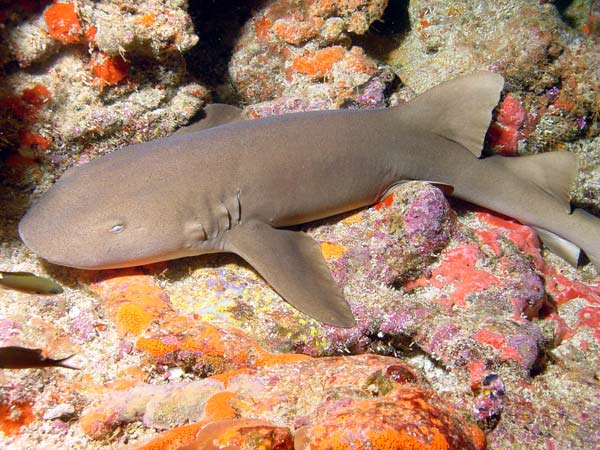
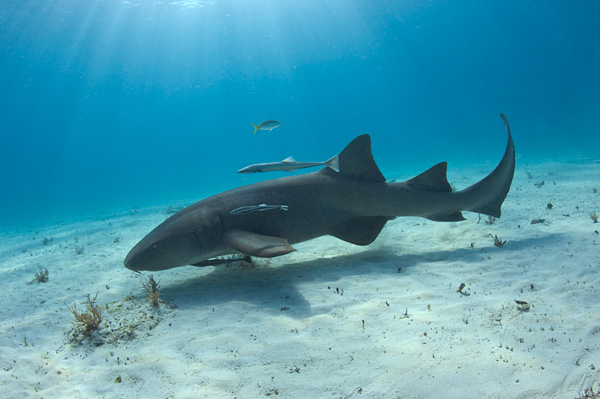
View all available Nurse Shark Pictures in the Shark Pictures Database Nurse shark, Common nurse shark, Atlantic nurse shark. Latin Name: Ginglymostoma cirratum. Family: Ginglymostomatidae Identification: Uniformly brown or gray body, paling slightly towards belly. Two dorsal fins of almost equal size close to tail. Head bulbous with small mouth. Mouth has a barbell on each side. Tail narrow with a large upper caudal lobe and no distinct lower lobe. Size: 5 to 9ft max. 14ft. Habitat: Found in many environments including reef flats, sandy areas, lagoons, and mangroves. From intertidal to 150ft. Abundance: This is the most commonly encountered shark on most Caribbean reefs. It can be locally common from Florida to Brazil. Distribution: On the Atlantic coast of the Americas from Rhode Island to Brazil. Bermuda and the Eastern Atlantic from Senegal to Gabon. Reports of Atlantic nurse sharks in the Eastern Pacific are misidentifications of the Pacific Nurse Shark Ginglymostoma unami. Behavior: Nocturnal. Sleeps under overhangs of reefs, or in mangroves during the day. Often found sleeping in small groups. At night forages for spiny lobsters, crabs, octopus, and sea urchins etc. May inhabit the same area for many years. Reproduction: Ovoviviparous. Conservation Status:
Surprisingly, the Atlantic Nurse Shark is listed as
Data deficient by the IUCN. Populations in some areas of the Caribbean
and the Bahamas are extremely well documented and populations in those (often
protected) areas appear to be stable. Photographs: Sail rock, Grenadines, St Vincent (top). Tiger Beach, Bahamas (bottom). Similar species: The common nurse shark is the only member of thee nurse shark family found in the Atlantic. Reports from the eastern Pacific represent occurrences of the newly described Pacific Nurse Shark Ginglymostoma unami. Reaction to divers: Lies motionless for much of the day unless closely harassed or in the vicinity of a shark feed. Will bite if provoked. Nurse sharks are opportunistic and become regular visitors to shark feeds. Diving logistics: Nurse sharks are extremely common sights in many areas of Florida, the Bahamas and the Caribbean. One particularly good place to dive with nurse sharks is at South Bimini Island in the Bahamas. From November to March, dive operators run Great Hammerhead Shark trips to a particular spot near Bimini Sands Resort. Although not the target species, score of nurse sharks often show up and settle down in front of the feeding crates to the chagrin of the feeders who then have to contend with them stirring up sand and trying to steel bait from the incoming hammerheads. Citation(s):
|
|
|
|
SHARK TRIPS |
 |
 |
 |
 |
 |
 |
 |
 |
|
MORE EXPEDITIONS |
 |
 |
 |
 |
 |
 |
 |
 |
 |
 |
 |
 |
|
|
|
SPONSORS |
 |
 |
|
ADVERTISERS |
|
|


|
|
|
ELASMO-BLOGS |
 |
 |
 |
 |
 |