|
Photograph copyright Andy Murch all rights
reserved
View all available
Spiny Butterfly Ray Pictures
Common Names:
Spiny Butterfly Ray, moth ray, butterflyray.
More
common names below text.
Latin Name:
Gymnura altavela
Family:
Gymnuridae
Identification:
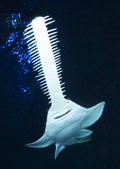
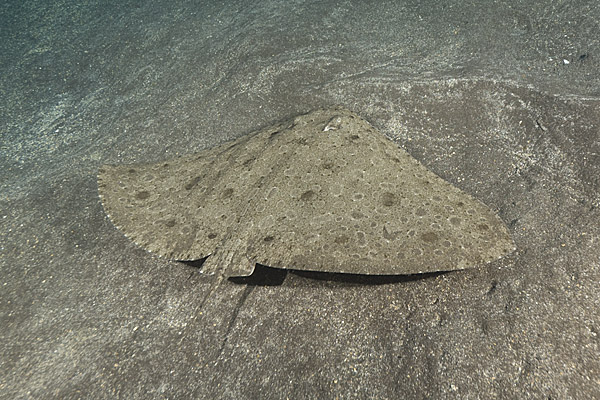
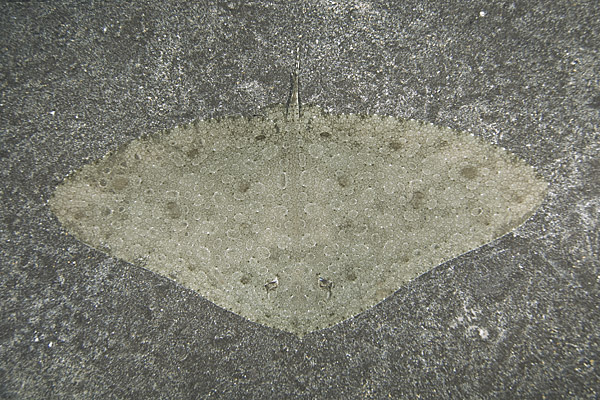
Disc width roughly twice length. Dorsum covered in
an intricate pattern of tiny lines and swirls that form light and dark brown
spots and larger irregular circles fringed with white. Ventrum white,
cream or with a pinkish hue. Short tail has one or two tail stings (unborn
embryos already have fully formed tail stings). Dorsal fin absent. Very low
dorsal and ventral finfolds on tail.
Size:
Wing
span to 400cm.
Habitat:
Sandy or muddy bays and brackish estuaries,
sometimes near
rocky
reef faces, and over sand flats. 2 to 100m depth.
Abundance and distribution:
Occurs in the eastern Atlantic Ocean from Portugal to Angola including the
Canary Islands, Madeira, and the Mediterranean and Black Seas. Also occurs in
the western Atlantic Ocean from Massachusetts to Argentina.
Behavior:
Lays motionless for much of the time under a thin covering of sand. Butterfly
ray footprints or beds (indentations left in the sand) can often be seen days
after the animal has moved on.
Feeds on fishes, crustaceans, mollusks and plankton.
Reproduction:
Ovoviviparous.
4-7 embryos. Gestation lasts for about 6 months. Once the unborn spiny butterfly
rays have completely used up the reserves in the yolk sac, the mother secretes
uterine milk. Long villi (filaments) grow from the uterus walls into the
embryo's spiracles. Milk can then be directed more efficiently into the embryo's
mouth and throat.
Photographs:
Los Gigantes, Tenerife,
Canary Islands, Eastern Atlantic Ocean.
Similar species:
Another species that shares the western range of the spiny butterfly ray is the
Smooth Butterfly Ray Gymnura micrura.
Reaction to divers:
If buried in the sand, the spiny butterfly ray will often remain motionless
while divers pass. Even after most of the sand has
been fanned away (as in the above picture) these rays are likely to remain
stationary as long as the observer uses slow, non threatening movements.
Diving logistics:
Spiny butterfly rays
are fairly abundant around the Canary Islands. Reportedly, there is one that has
taken up residence in the harbor on El Hiero. I have seen many beds in the El
Cabron Marine Park but no actual animals.
Occasionally spiny butterfly rays attend the organized ray feeds at
Los Gigantes on Tenerife (where the featured specimen was seen). Los Gigantes Diving offers freestyle feeds
once or twice per week. The divemaster takes a huge barrel of fish scraps to
60ft and offers them to the eagerly gathering ray species. After a while the
human participants usually help themselves to some fish and wander off to
interact with the rays on their own. The feed can be rather chaotic but the ray
action is almost guaranteed. Attending species include common eagle rays, common stingrays, roughtail rays, round stingrays and
occasionally angel sharks, butterfly rays, and marbled torpedo rays.
Very occasionally a large Bull Ray swims by.
Contact Los Gigantes Dive Centre for further information.
Further reading:
Sharks
and Rays - Elasmobranch Guide of the World. Ralf M. Hennemann. IKAN.
Other names of the
Spiny Butterfly Ray:
大燕魟
China Main
Chinese
大燕魟
China Main
Mandarin Chinese
скат-бабочка обыкновенная
Russian Fed
Russian
Πλατυσέλαχο
Greece
Greek
Aeroplanke
Albania
Albanian
Altavela
Italy
Italian
Arraia-borboleta
Brazil
Portuguese
Arraia-manteiga
Brazil
Portuguese
Avejão
Portugal
Portuguese
Bâsternâk
Lebanon
Arabic
Borboleta
Brazil
Portuguese
Breamanta
Portugal
Portuguese
Bugghiu
Italy
Italian
Butterfly ray
UK
English
Choucka bastarda
France
French
Doornvlinderrog
Netherlands
Dutch
Farfett
Malta
Maltese
Gavila
Italy
Italian
Giant butterfly ray
Cuba
English
Ignelivatoz
Turkey
Turkish
Isoperhosrausku
Finland
Finnish
Kazıkkuyruk balığı
Turkey
Turkish
Khop
Mauritania
Wolof
Köppor
Mauritania
Wolof
Manta
Spain
Spanish
Manteddu
Italy
Italian
Mantellina
Canary Is.
Spanish
Mariposa
Canary Is.
Spanish
Marmorerad fjärilsrocka
Sweden
Swedish
Masca
France
French
Milá
Spain
Spanish
Motýlovec trnitý
Czech Rep
Czech
Mourine bâtarde
Mauritania
French
Pastenague ailée
France
French
Pastigue de Columna
France
French
Pastinaca
Spain
Spanish
Peitschenrochen
Germany
German
Pigrokke
Denmark
Danish
Pilrokke
Norway
Norwegian
Pilskate
Norway
Norwegian
Pisciu vela
Italy
Italian
Platyselacho
Greece
Greek
Ptaszyca
Poland
Polish
Raia-borboleta
Brazil
Portuguese
Raia-gererera
Brazil
Portuguese
Raia-manteiga
Brazil
Portuguese
Raie aigle
Mauritania
French
Raie papillon
Mauritania
French
Raie-papillon épineuse
France
French
Raya mariposa
Spain
Spanish
Raya mariposa espinuda
Spain
Spanish
Rayamariposa
Spain
Spanish
Σαλάχι πλατύπτερο
Greece
Greek
Sálahi trygéna
Greece
Greek
Siba zutulja
SerbiaMontenegro
Serbian
Stechrochen
Germany
German
Stingrocka
Sweden
Swedish
Stor sommerfuglerokke
Denmark
Danish
Tavela
Italy
Italian
Tavila
Italy
Italian
Trigóna
Greece
Greek
Uge-manta
Portugal
Portuguese
Uge-mata
Portugal
Portuguese
Vaca
Spain
Spanish
Vela
Spain
Spanish
Vela italiana
Spain
Spanish
Vela latina
Mauritania
Spanish
Vela-latina
Portugal
Portuguese
Volina
SerbiaMontenegro
Serbian
Vugghiu mantellinu
Italy
Italian
|