Not just a
huge collection of
Shark
Pictures:
Elasmodiver.com contains images of sharks, skates, rays, and a few
chimaera's from around the world. Elasmodiver began as a simple web
based
shark
field guide
to help divers find the best places to encounter the different
species of sharks and rays that live in shallow water but it has
slowly evolved into a much larger project containing information on
all aspects of shark diving and shark photography.
There are
now more than 10,000 shark pictures and sections on shark
evolution, biology, and conservation. There is a large library of
reviewed shark books, a constantly updated shark taxonomy page, a
monster list of shark links, and deeper in the site there are
numerous articles and stories about shark encounters. Elasmodiver is
now so difficult to check for updates, that new information and
pictures are listed on an Elasmodiver Updates Page that can be
accessed here:
Identification:
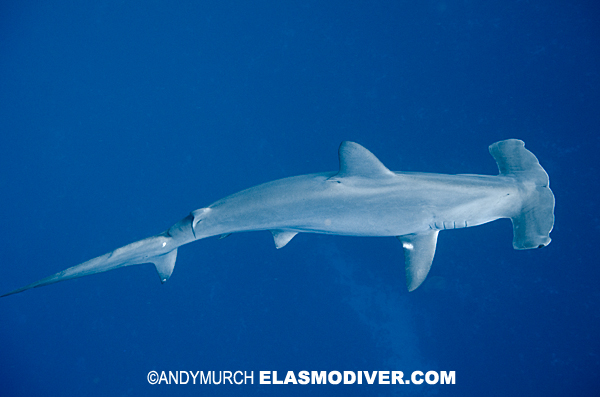
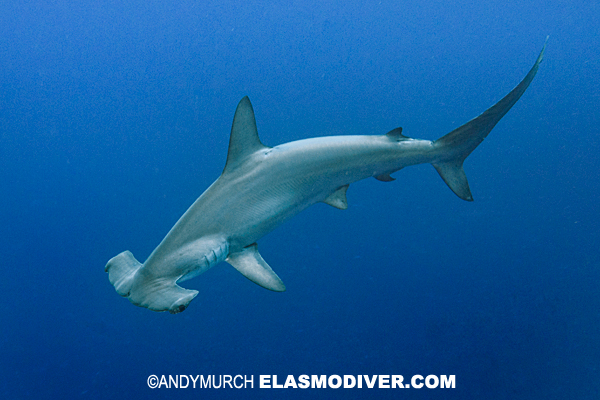
Leading edge of hammer
arched with well defined indentations. Pectoral fins have dark tips. Pelvic fins
not falcate. Body grey to greyish brown. Ventral
surface pale.
Size:
Maximum
length 420 cm. 42 - 55 cm at birth.
Habitat:
In shore to off shore sea mounts. Adults are pelagic. Intertidal to 275
meters.
Abundance
and distribution: Circumtropical/temperate.
Behavior:
One
of very few large sharks observed schooling in great numbers. Diet consists of
bony fishes, sharks, rays, crustaceans, and octopus.
Reproduction:
Viviparous.
The hammerhead are considered the most highly evolved of the shark families.
Conservation Status: ENDANGERED. All life-stages are vulnerable to
capture as both target and bycatch in fisheries: large numbers of juveniles are
captured in a variety of fishing gears in near shore coastal waters, and adults
are taken in gillnets and longlines along the shelf and offshore in oceanic
waters. Population segregation and the species? aggregating habit make large
schools highly vulnerable to fisheries and means that high CPUEs can be
recorded, even when stocks are severely depleted. Hammerhead shark fins are more
highly valued than other species because of their high fin ray count, leading to
increased targeting of this species in some areas. Where catch data are
available, significant declines have been documented: both species-specific
estimates for S. lewini and grouped estimates for Sphyrna spp combined suggest
declines in abundance of 50-90% over periods of up to 32 years in several areas
of its range, including South Africa, the northwest and western central Atlantic
and Brazil. Interviews with fishermen also suggest declining trends. Similar
declines are also inferred in areas of the species? range from which specific
data are not available, but fishing pressure is known to be high. Although S.
lewini is relatively fecund compared to other large sharks (with litters of
12-38 pups) the generation period is greater than 15 years in the Gulf of Mexico
and its life-history characteristics mean that it resilience to exploitation is
relatively low. Given the major declines reported in many areas of this species?
range, increased targeting for its high value fins, low resilience to
exploitation and largely unregulated, continuing fishing pressure from both
inshore and offshore fisheries, this species is assessed as Endangered globally.
Citation: Baum, J., Clarke, S., Domingo, A., Ducrocq, M.,
Lamónaca, A.F., Gaibor, N., Graham, R., Jorgensen, S., Kotas, J.E., Medina, E.,
Martinez-Ortiz, J., Monzini Taccone di Sitizano, J., Morales, M.R., Navarro,
S.S., Pérez-Jiménez, J.C., Ruiz, C., Smith, W., Valenti, S.V. & Vooren, C.M.
2007. Sphyrna lewini. In: IUCN 2012. IUCN Red List of Threatened Species.
Version 2012.2. <www.iucnredlist.org>
Observations:Scalloped
hammerheads have been well documented swimming in huge schools around various
sea mounts off of central and South America. They apparently use cleaning
stations in these areas to rid themselves of parasites.
Photographs:
Yonaguni Island, Ryukyu Archipelago, Japan.
Similar species:Great
hammerhead distinguished by straighter leading edge of hammer, proportionately
taller dorsal fin, and often larger size.
Reaction to divers:Shy. Very
difficult to approach when viewed in schooling behaviour. Most divers have
better success when using rebreathers. Can
be aggressive making close passes in baited situations.
Diving
logistics: Various
operators go from La Paz to the sea mounts in the Sea of Cortez to view
schooling Scalloped hammerheads but in recent years the schools have dwindled
due to heavy over fishing. The Galapagos, Malpelo, and Cocos Island remain the
best places for close encounters but all stocks are stressed by longlining and
numbers vary from year to year. El Nino years may see less hammerheads as the
water becomes too warm at recreational scuba depths and the sharks stay deeper.
Following El Nino years may see the best schooling activity as the sharks are
then in dire need of the cleaning stations that they were unable to reach the
previous year. The undersea hunter out of Costa Rica travels to Cocos for 1-2
week long trips that also expose divers to silkies, whitetips, silvertips,
occasional whale sharks, marbled rays, and other species of elasmos.