|

View all available
Spiny
Dogfish Pictures
Common Names:
Spiny
dogfish, Common spiny dogfish, Piked dogfish, Mud shark.
Binomial Name:
Squalus acanthias
Family:
Squalidae
Identification:
Long,
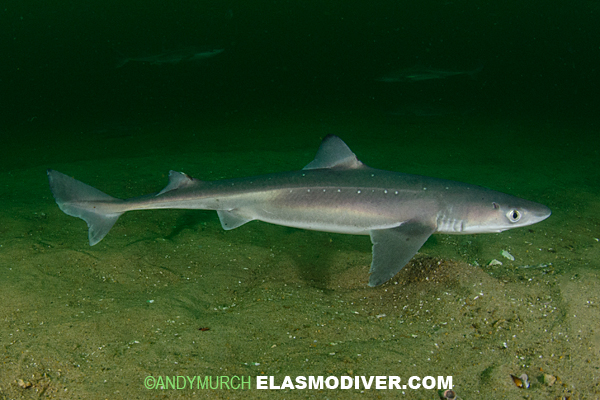
flattened, pointed snout. Grey to brown above usually with small white spots.
White spots may follow lateral line. Eyes large. Mildly venomous spines on
first and second dorsal fins. Anal fin absent. Belly white.
Size:
Maximum
length 1.6 meters. size at birth 22-33 cm. Maximum recorded age 66 years.
Habitat:
Often
cruise over sand
and mud bottoms. Also frequently encountered over rocky reefs. From 0 to 900 meters.
Inhabits estuarine, coastal and offshore waters sometimes migrating over great distances Newfoundland tagged individuals have been captured years later in Iceland.
Normal migration patterns are usually more localized; Western Atlantic groups migrate between Canada and the US.
Abundance and distribution: North and South Atlantic Ocean and South Pacific and Southern Ocean around
Australia. Some populations may eventually be recognized as new species or
distinct 'sub species'. An example of this is the recent resurrection of the
North Pacific Spiny Dogfish ~ Squalus
suckleyi.
The spiny dogfish's western range extends along the
east coast of North America from Labrador to the Gulf of
Mexico. Some populations are locally abundant
while others have experienced steep declines leading to drastically reduced
fishing quotas (especially in Europe). In the UK and Europe Spiny dogfish are
the principal fish utilized in "fish and chips". They are also ground up to
be used in fertilizers.
Behavior:
Cruises
over soft bottoms either alone or in small groups. Occasionally schools (often
segregated by sex) in response to food supply such as squid or salmon runs. May also
form schools with other species such as leopard sharks and smoothhounds. Diet
consists mainly of bony fishes. Other foods include octopus, squid and
crustaceans.
Reproduction:
Ovoviviparous.
Litter size from 1- 20. Spiny dogfish have a slow maturity rate (around 12 years) which makes them very vulnerable to
over fishing. They also have the longest gestation period of any known
vertibrate 18-24 months.
Conservation Status:
the spiny dogfish debate
Listed by the IUCN as 'Vulnerable': Most stocks are
highly migratory, but there is no regional fisheries management for the species.
Management is in place in only a few range states and in only a limited part of
the range of highly migratory stocks. Although naturally abundant, this is one
of the more vulnerable species of shark to over-exploitation by fisheries
because of its late maturity, low reproductive capacity, longevity, long
generation time (25 to 40 years) and hence a very low intrinsic rate of
population increase (2 to 7% per annum). Population segregation and an
aggregating habit make mature (usually pregnant) females highly vulnerable to
fisheries even when stocks are seriously depleted. This aggregating habit also
means that catch per unit effort (CPUE) is not an adequate indicator of stock
status; high CPUE can be maintained even when populations are severely depleted.
Some targeted Squalus acanthias fisheries have been documented for over 100
years. Fisheries stock assessments report a decline in total biomass of >95%
from baseline in the Northeast Atlantic, where catch effort is effectively
unlimited. Mediterranean and Black Sea stocks are also unmanaged, with a >60%
decline reported in a Black Sea stock assessment for 1981 to 1992. There has
been a decline in biomass of mature females of 75% in just 10 years in the
Northwest Atlantic, where US federal efforts to manage the stock are hampered by
high bycatch, continued exploitation in Canadian Atlantic waters, and regular
defiance of scientific advice by US Atlantic states. European demand continues
to fuel markets around the world. Fisheries and population trend data indicate
that the southern part of the Northeast Pacific stock has also declined through
overfishing, but stocks appear stable off Alaska. The only data identified from
the Northwest Pacific are from Japan, where landings of spurdog declined ~80%
between 1952 and 1965, and inshore spurdog CPUE declined 80 to 90% from the mid
1970s to late 1990s. Unregulated and expanding target and bycatch fisheries take
spiny dogfish in South America (Europe reports imports from this region), where
population declines are reported. New Zealand manages the species, which is
taken in target and bycatch fisheries, through its Quota Management System.
There is only limited fishing pressure in Australia and South Africa, with most
catches discarded.
Photographs: Rhode
Island, New England, USA. North Atlantic Ocean
Similar species:
The virtually identical
North Pacific Spiny
Dogfish Squalus suckleyi does not occur in the same areas as the
spiny dogfish. The Smooth
Dogfish or dusky smoothhound mustelus canis which has a sympatric range from the Bay of Fundy
to the Gulf of Florida and from Southern Brazil to Argentina is easily
recognizable as it lacks fin spines.
Elsewhere, there
are many other similar dogfish species but most do not enter shallow water.
Reaction to divers:
These
are curious and harmless sharks that will often closely approach divers and on
occasion accompany them on their dives. If divers are buzzed by a dogfish they can
often be recalled by tapping two stones together. The dogfish seem to find this irresistible
and will repeatedly return to satisfy their curiosity. If engaging in dogfish
feeds it is possible to play tug of war with these little sharks. Care should be
taken to avoid their mildly venomous spines.
Diving logistics:
Spiny dogfish are sometimes attracted to inshore shark feeds organized in New
England.
As spiny dogfish
schools are reported to reach plague like proportions in some areas, it may be
possible to easily attract quite large numbers although the appearance of the
schools is hard to predict. If planning to chum, try the summer months when the
Gulf Stream has moved in towards shore.
References and citations:
Resurrection and redescription of Squalus suckleyi (Girard,
1854) from the North Pacific, with comments on the Squalus acanthias subgroup (Squaliformes:
Squalidae)
DAVID A. EBERT 1, 2, 3, 8, WILLIAM T. WHITE 4, KENNETH J. GOLDMAN5, LEONARD
J.V. COMPAGNO6, TOBY S. DALYENGEL7 & ROBERT D. WARD4
Migration Patterns of Spiny Dogfish (Squalus
acanthias) in the North Pacific ocean - G.A. McFarlane and J.R. King. -
Fisheries and Oceans Canada.
IUCN RED LIST STATUS Fordham, S., Fowler, S.L., Coelho, R., Goldman, K.J. & Francis, M.
2006. Squalus acanthias. In: IUCN 2013. IUCN Red List of Threatened Species.
Version 2013.1. <www.iucnredlist.org>.
|